Urge Purdue University to prioritize teaching practices to align with those recommended by the AAVMC
Bret D. Marsh, DVM
Dean, Purdue University College of Veterinary Medicine
Chief Executive Officer, Purdue University Veterinary Hospital
Clinical Professor, Veterinary Medicine
Veterinary Administration | Purdue University Veterinary Hospital
Purdue University College of Veterinary Medicine
625 Harrison Street
West Lafayette, IN 47907
765-494-7608
765-496-6235 (fax)
marsh98@purdue.edu
Dear Dr. Marsh,
We know effective veterinary student education is important to the Purdue University College of Veterinary Medicine. We hope to meet with you to discuss how we might help Purdue improve the current classes that involve the unnecessary killing of healthy animals for student education. We believe graduating students should be confident practitioners and surgeons. This means giving them ample opportunity for live tissue handling and post-anesthesia recovery—skills best obtained on patients who need procedures under the guidance of experienced veterinarians.
Our paper, “A Public Records Review of Cadaver and Terminal Animal Use in U.S. and Canadian Veterinary Schools,” was recently published in the Journal of Veterinary Medical Education.
We reviewed animal use protocols from nearly every public veterinary school in the United States and Canada, including Purdue. We evaluated the degree to which protocols adhered to the AAVMC Guidelines for the Use of Animals in Veterinary Education, which, as you know, recommend best practices for the use of animals in teaching. In particular, the AAVMC Guidelines stress using animals in ways that minimize harm while achieving student learning outcomes. For example, cadavers should be sourced ethically and humanely, alternatives to animals should be considered whenever possible, and teaching policies should emphasize that invasive procedures only be performed when there is a clear medical benefit to the animal.
Among the records we obtained from Purdue University were the following protocols:
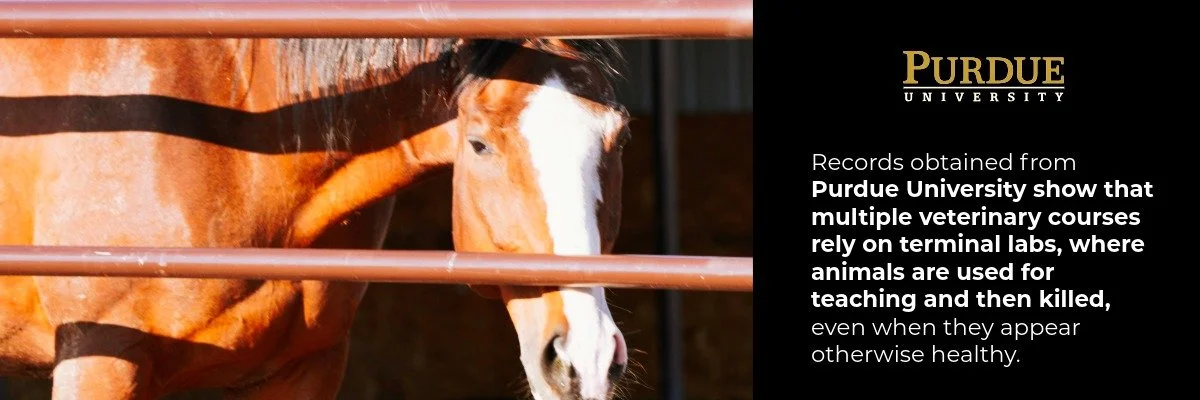
· VCS 82200 and 82300 Large Animal Junior Surgery Laboratory: In this protocol, up to 47 sheep and four horses are requested per year to teach veterinary students in terminal surgery laboratories. The animals are sourced from the university and appear to be otherwise healthy.
· VCS course 85100 Non-traditional pet medicine and surgery: In this protocol, chickens are used in terminal labs to teach medical procedures. After they are killed, the cadavers are used for other teaching purposes. The protocol we received did not specify the number of animals per year expected to be killed. The birds are sourced from the university. They are cull birds but the protocol is unclear whether or not this status is due to medical reasons, or if these animals could potentially be adopted.
· Small Animal Teaching Blanket Protocol: This protocol is for teaching veterinary students, interns, residents, veterinary technician students, and veterinarians a variety of medical and surgical procedures. Only animals donated for medical or economic euthanasia will be euthanized, and at least some of these animals will be used in terminal surgeries. The number of animals expected to be euthanized each year is not stated in the protocol that we received. It should be noted that the AAVMC Guidelines do not recommend terminal surgeries as a method of teaching, even using donated animals.
· Large Animal Teaching Blanket Protocol: This protocol is for teaching medical and surgical procedures to veterinary students, interns, residents, veterinary technician students, and veterinarians. Only animals donated for medical euthanasia or due to economic hardship by the owner that cannot be transferred to a herd or another protocol will be euthanized. The number of animals expected to be euthanized each year is not stated in the protocol that we received.
· Fish Medicine: In this protocol, up to 15 fish are killed each year for teaching medical procedures and anatomy/necropsy to veterinary students. The fish are sourced from the university aquaculture facility. The fish are sedated and medical procedures are performed before they are euthanized and used for the anatomy lab. It appears that the fish are otherwise healthy.
· Avian handling and simple procedures: This lab is for teaching physical examination and sample collection on live birds and procedures on deceased birds to veterinary students and veterinarians. Up to 30 birds per year are requested. The birds are sourced from a vendor and appear to be otherwise healthy. The protocol is vague, but it appears that the birds are first used in the lab while alive, then killed and the cadavers are used for the remainder of the lab.
· Small Animal Medicine Emergency Procedure Wet Lab: This protocol is for teaching emergency medical and surgical procedures to interns. The lab is a terminal surgery laboratory for up to 3 dogs per year. The dogs are sourced from a vendor and there is no indication that these animals are unhealthy or otherwise slated for euthanasia. The papers cited in the justification are from 2007 or earlier. No other veterinary school provided a similar protocol for teaching veterinary students or interns emergency procedures, and only one submitted a similar protocol for teaching emergency and critical care residents. Thus, the necessity of this protocol is highly questionable.
In evaluating animal use protocols from veterinary schools, we were impressed by the innovative and effective programs that schools have developed for teaching veterinary students, residents, and interns. These include programs that prioritize access to care by allowing students to perform medically necessary procedures on animals under the supervision of experienced instructors, robust willed-body programs, providing care to farmed animal sanctuaries, low- or no-cost castration clinics for horses, and providing services for farmed animal producers. We also saw many examples of schools integrating effective instructional tools, such as manikins, simulators, low- and high-fidelity models, and software, to enhance student learning as recommended by the AAVMC. The AAVMC Use of Animals in Veterinary Education Handbook provides an in-depth review of the benefits of these teaching methods, as well as practical advice on implementing them in veterinary school curricula.
We recognize that animals must be used in veterinary education; it is imperative that schools use them effectively while protecting our profession’s reputation as courageous advocates for animals. As a leader in veterinary education, your institution has a duty to uphold the highest standards of effective animal use, not only in practice but also in the training of future veterinarians. Therefore, we urge you to prioritize transitioning your schools’ teaching practices to align with the AAVMC's recommendations. We would welcome the chance to discuss this with you.
Thank you for your time and thoughtful consideration of this matter. We believe that by embracing these effective changes, you will excel in training courageous, skilled, and confident veterinarians for the future.
Sincerely,
Crystal Heath, DVM
Co-Founder
Our Honor
