Request for AVMA Delegates to Condemn the New AVMA Guidelines for the Depopulation of Animals
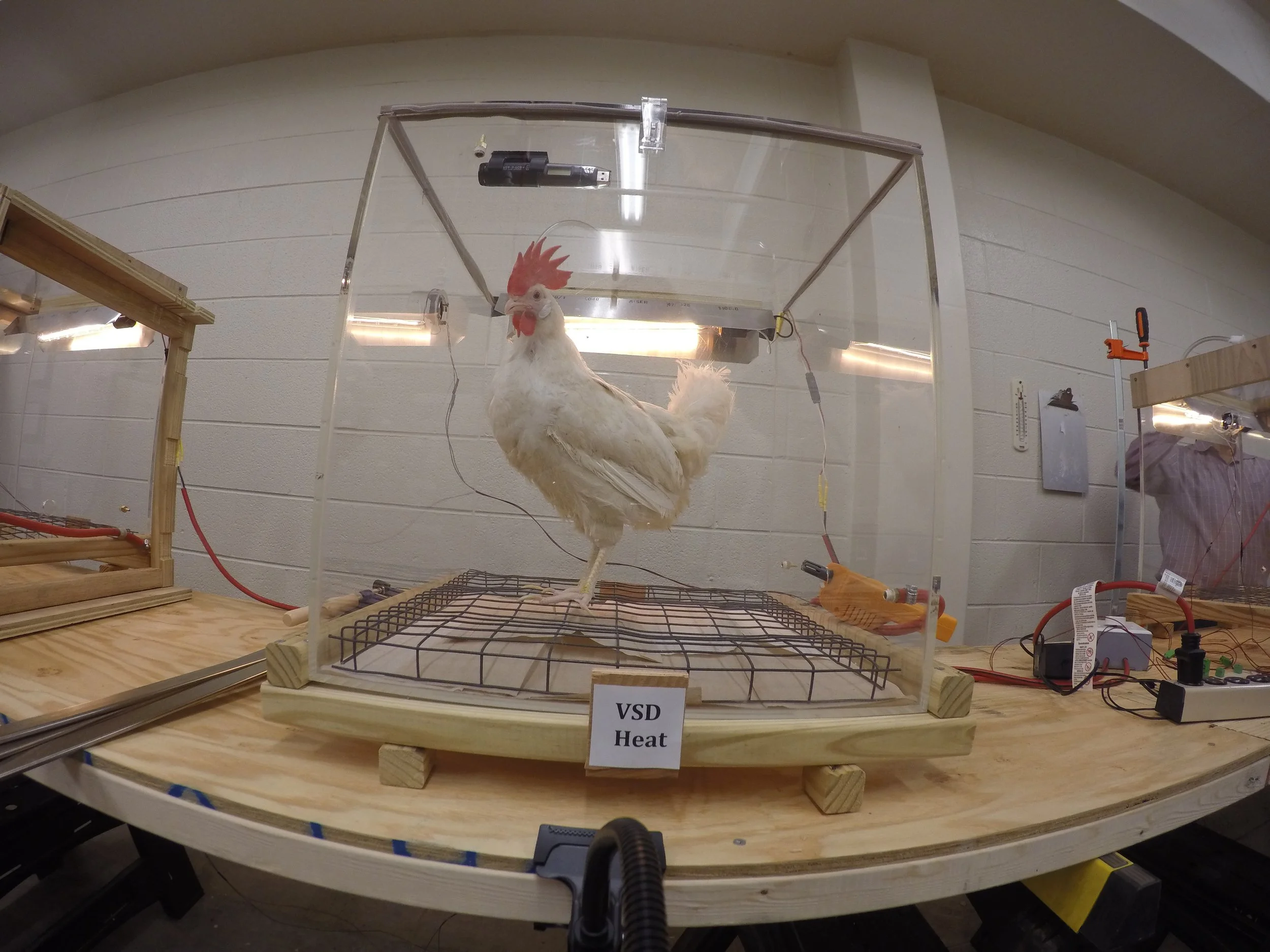
A chicken is placed in a box for an experiment involving VSD+ performed at the Prestage Department of Poultry Science at North Carolina State University. This footage was obtained via public records request from Animal Outlook.
As a veterinary advocacy organization, we believe that meaningful change within the AVMA is driven by its members. Delegates, state VMAs, and local VMAs are responsive to the veterinarians they represent, and direct engagement is one of the most effective ways to influence the culture and policy direction of our profession. Sharing your perspective with your delegates and professional associations is how institutional change occurs. For this reason, we encourage all veterinarians, including those who are deeply critical of the AVMA, to remain engaged and make their views known. You are welcome to copy and paste the letter below to send to your representatives, and to sign in solidarity with others calling for the AVMA to uphold the standards and commitments of the veterinary oath.
Sign into AVMA.org to find the contact information for your delegates.
Dear AVMA Delegate,
I am writing to you as a veterinarian to express my deep disappointment with the newly released edition of the AVMA Guidelines for the Depopulation of Animals and to urge you, as elected representatives of this profession, to publicly condemn this document. In its current form, these guidelines are not aligned with the veterinary oath, nor do they reflect the values, expectations, or professional judgment of the vast majority of veterinarians.
Unfortunately, the content of this new edition is exactly what many of us feared. These guidelines, which are relied upon by government agencies to dictate policy during emergencies and infectious disease outbreaks, continue to legitimize some of the most cruel methods of mass killing. Chief among them is ventilation shutdown plus, a process that involves sealing animals inside buildings, pumping in heat, and waiting for them to die. This method remains listed as a Tier 2 method for poultry and a Tier 3 method for pigs, despite overwhelming professional opposition, extensive evidence of severe animal suffering, and a violation of some animal cruelty laws.
The shift to a tiered system has not meaningfully addressed these concerns. While the previous classifications of “recommended,” “recommended in constrained circumstances,” and “not recommended” have been replaced, the new tiers function in much the same way. Tier 1 methods are described as those that optimize welfare outcomes, while Tier 3 methods are acknowledged to have limited or no evidence supporting their use or evidence contrary to good animal welfare. The result is a semantic restructuring that preserves the same outcomes while attempting to maintain public trust.
This persistence is particularly troubling given the clear stance of the profession. A poll of more than 3,000 veterinarians on the Veterinary Information Network found that only 1.1 percent believe ventilation shutdown plus is an ethical and humane method of mass killing. Thousands of veterinarians have organized, signed statements, and spoken publicly against it. Continuing to endorse this method despite such overwhelming opposition erodes trust in the AVMA and calls into question whose interests are truly being served.
At the end of 2020, AVMA-member veterinarians petitioned the AVMA and proposed a resolution to reclassify this method as a “not recommended” form of depopulation. The House of Delegates voted to put the question back to the Panel on Depopulation. Another AVMA-member-driven petition was submitted. However, it was rejected by the AVMA and was not allowed a vote, and the AVMA quietly amended the House of Delegates manual to prevent similar future petitions from advancing.
Less cruel alternatives exist. High-expansion nitrogen foam and nitrogen gas can induce unconsciousness within seconds and death within minutes. These methods are well documented, and we are thankful that they were included in the new edition of the guidelines, yet corporations have little incentive to implement them when cheaper methods, such as ventilation shutdown plus, remain permissible.
Corporations receive USDA indemnity payments when the methods used are legitimized by the AVMA guidelines. Hundreds of millions of taxpayer dollars have been distributed to some of the largest corporations in the world, even as egg prices rise and these companies rely on ventilation shutdown plus after failing to prepare for less cruel options.
The influence of these guidelines extends far beyond the United States. The AVMA is looked to globally as an authority in setting animal-killing policy. As climate emergencies and infectious disease outbreaks become more frequent worldwide, legitimizing these methods ensures their wider adoption. This places the AVMA in the position of exporting cruel practices under the banner of professional guidance.
The guidelines themselves repeatedly invoke the concept of a humane approach, stating that depopulation should minimize pain and distress before loss of consciousness and reflect an approach expected by society. Yet the word humane is never defined. By its ordinary meaning, humane implies benevolence and concern for suffering. Some of the methods legitimized in these guidelines are not consistent with what society expects, nor with what most veterinarians want their profession to endorse.
Beyond ventilation shutdown plus, the new edition contains additional deeply concerning classifications. Water-based foam is listed as a Tier 1 method for pigs and a Tier 2 method for other species, despite evidence that death occurs through airway obstruction. The Veterinary Association for Farmed Animal Welfare has explicitly condemned this classification, citing findings from the European Food Safety Authority that describe this method as highly painful and equivalent to drowning or suffocation.
Manual blunt force trauma is listed as a Tier 1 method for suckling pigs, even though research demonstrates that determining consciousness is difficult and repeated blows are common, with a low probability of achieving immediate death. VAFAW has likewise called for this method to be removed from Tier 1 and reassigned to Tier 3.
The inclusion of DRC 1339 (3-chloro-4-methyl benzenamine HCl), a slow-acting avicide that takes one to three days to cause death, as a Tier 3 method for wild birds further illustrates how far depopulation standards have diverged from fundamental animal welfare principles. This chemical allows animals to disperse and die in public view, poses risks to non-target species, and is highly toxic to humans, yet it is still categorized as an acceptable option within this framework.
Equally troubling is what the guidelines omit. Research critical of endorsed methods, including the paper “The Rise of Heatstroke as a Method of Depopulating Pigs and Poultry: Implications for the US Veterinary Profession,” is absent from discussions of ventilation shutdown plus. This selective use of evidence undermines claims that these guidelines reflect transparency, accountability, and advances in animal welfare science.
The framing throughout the document raises serious concerns. Public perception is repeatedly discussed, not as a reflection of legitimate concern, but as a logistical obstacle to be managed. Priority is placed on shielding the public from witnessing violence rather than on preventing that violence. Recommendations to conduct killing out of public view, use visual barriers, involve law enforcement, restrict access by caretakers, and warn the public about liability for attempting to prevent depopulation blur the line between animal health response and coercive population control. Compliance is prioritized over consent, and the human-animal bond is treated as a risk factor rather than a value to be respected.
In the section regarding fur-bearing animals, the AVMA’s endorsement of regulatory capture is deeply concerning. Fur-bearing animals are exempt from key federal protections, while industry groups such as Fur Commission USA are treated as credible authorities on humane standards. Industry-developed killing methods, including the use of carbon monoxide, are incorporated into depopulation guidance with little critical scrutiny. In doing so, veterinarians are placed in the position of laundering industry practices through professional legitimacy and protecting public trust in the industry.
The guidelines state that member feedback is incorporated and that future revisions will continue to reflect advancements in animal welfare science. Yet the continued endorsement of ventilation shutdown plus, despite the fact that only 1.1 percent of surveyed veterinarians view it as ethical and humane, and not including work critical of the methods endorsed directly contradicts that claim.
As veterinarians, we swear an oath to protect animal welfare, relieve animal suffering, and serve society with integrity. Endorsing guidelines that normalize prolonged suffering, obscure violence from public view, and align professional authority with corporate convenience is not consistent with that oath. I urge you, as AVMA Delegates, to condemn this edition of the Guidelines for the Depopulation of Animals and to demand a fundamental reassessment grounded in independent science, genuine professional consensus, and the core obligations of our profession.
Sincerely,
Crystal Heath, DVM
Kristen Smolinski
Nicole Corrado
Ellie Shelburne DVM
Laura Cochrane DVM
Debbie Wall
Dana Walker
Lynn Hoang
Erik LaRue
Silvia Rocha
Jeri Cheraskin DVM
Pamela Burdine
George Bates, DVM, MS
Shannon Hunter
Jennifer R.
Blackburn
Brian Field
Nora Coyle, MSW
Heather T Carleton
Cierra Buer, DVM
Brenda K Forsythe, MS, PhD, DVM
Linda R Savage
Guy Fagot
Erin Zamzow DVM
Madeline Graham, DVM
Daryl Denning
Barbara Goodrich, Ph.D., D.V.M.
Maria Jose DVM
Verena Bracher PhD, Dr.med.vet.
Victoria Jepson
Jessica Cioffi
Kim Culbertson DVM
Flora Pino García
Martha Burton
Emma Bratton
Larrea Cottingham
Gloria Navan
Gary Block DVM
Michael Davanzo
Alana Willroth
Cynthia Ann Allen
Ronald Celella, DVM
Melissa A. McCormick, MSc, RVTg
Laura Sminkey
Jim Loveland
Hillary Liband, M.A.
Chantal Melissa Eldridge
Sarah Sutton MRCVS
Kristina Clarke
Sunshine Eckstrom DVM, CPEV
Alana Willroth
Amy Drowns
Dana Griffith, DVM
Cynthia Marrs
Beth Eardley
Isabelle Tassi
Marina Galvan-Clary
Mary Whitney Walters
Alexandra Bedford DVM
Rebecca Stuntebeck
Gina Geisel
Erika Hoffeld, DVM, DACVP
Jessica Arbuckle
Molly Nemec
Dr. Alexa Martinelli
Judy bash
Elaine Livesey-Fassel
Gaston Kojusner
Gail Hansen, DVM, MPH
Jacqueline MacDonald
Debbie Wall
Christine Davies, DVM
Andrea Reese RVT
Risa M Mandell, LCSW
Brigit Villines, DVM
Emma Devereux
Judit Szamos DVM
Jennifer R.
Irene Salagaras
Lisa Scharin
Allison Pang
chafkin, dvm, tabatha
Corey Mullen
James Armer
Kevin Boileau
Avi Shaprut
Elizabeth Welch, DVM
Jennifer Doll
Karen Emanuel
Gary Block DVM, MS, DACVIM
darlene oliver
Sperry, Elisabeth DVM
Sean Mather
Becky L. Morrow, DVM, MS
Elena Contreras, DVM, MS, PhD
Monica Ramirez
Sara C. White, DVM
Scott Ford, DVM DABVP-Avian
Loren Reynolds DVM
Lucy Hurlock, VMD
Rhonda Savage
Maaike Dijkhorst

