Keep the “Save Our Bacon” Act Out of the Farm Bill

Gestation crates at Fair Oaks Farms in Fair Oaks Indiana. Taken during the tour on June 6, 2025
Please copy and paste the letter below and send it to your representatives.
Please call your senators today!
Use the Capitol Switchboard: (202) 224-3121
Tell them: Keep the so-called “Save Our Bacon” Act out of the Farm Bill
You can also sign on to this letter below. But sending it personally is more effective. Do both!
Download our free flyers for your clinic and outreach!
Subject: I Urge You to Keep the Save Our Bacon Act Out of the Farm Bill
Dear [Senator] [Last Name],
The Senate Agriculture Committee held a closed-door, bipartisan, members-only meeting on the Farm Bill. Chairman John Boozman, Republican of Arkansas, reportedly told committee members that he does not plan to include the Save Our Bacon Act in the Senate’s starting draft. We need to keep it that way.
Senators on the Agriculture Committee may still try to add it back in through an amendment. Please don’t let this happen.
As a constituent, I am writing to urge you to keep the “Save Our Bacon” Act out of the Farm Bill. This provision would override voter-approved state laws that were enacted to reduce the sale of some meat from pigs whose mothers were subjected to extreme confinement.
State laws addressing animal production are rooted in legitimate public health, consumer protection, and animal welfare concerns. The Supreme Court upheld a state’s authority to regulate products sold within its borders in National Pork Producers Council v. Ross. Congress should not now use the Farm Bill to nullify the will of voters or strip states of their ability to set basic standards for products sold to their residents.
Gestation crates confine pregnant pigs so tightly that they cannot turn around. A substantial body of veterinary and animal welfare science shows that this confinement causes physical and psychological harm, including abnormal repetitive behaviors, elevated stress responses, injuries, and the deprivation of basic movement and social behavior.
These concerns are not merely ethical. Intensive confinement can also create public health risks. Confining pregnant pigs in gestation crates elevates stress, suppresses immune function, and can increase pathogen growth, shedding, and transmission. These risks do not remain isolated on the production side of the supply chain. Piglets born to stressed, immunosuppressed sows can be more vulnerable to infection, while piglets of group-housed sows show better resistance and resilience and are exposed to fewer pathogens. Infected pigs may remain asymptomatic through slaughter, allowing contaminated pork products to reach consumers.
Pork is now a leading source of foodborne illness in the United States, responsible for an estimated 787,000 illnesses annually. Pathogens associated with pork production include Salmonella, Campylobacter, Yersinia, Listeria, Staphylococcus aureus, hepatitis E virus, and Toxoplasma gondii. Many of these pathogens can evade detection during routine inspection, and several are increasingly resistant to medically important antibiotics.
The risks are substantial. Salmonella alone is responsible for an estimated $1.9 billion in annual public health costs, and 60% of sows test positive for it. Ten percent of these strains are multidrug-resistant. Campylobacter from pork causes an estimated 37,000 infections in the United States annually, and 83% of Campylobacter found on commercial pork chops is resistant to at least one medically important antibiotic.
The overuse of antibiotics in pork production worsens this crisis. According to FDA data, 89% of pork producers administer antibiotics through feed or water, and 27.1% of all medically important antibiotics sold in the United States are used in pork production. This contributes directly to the rise of antimicrobial resistance, a global public health threat that the World Health Organization has estimated is responsible for hundreds of thousands of deaths each year.
State laws cannot solve every problem in pork production, but they can create a floor below which the treatment of pregnant pigs cannot fall and reduce reliance on one of the most extreme forms of confinement in modern animal agriculture.
This concern is widely shared by veterinarians. In a survey of veterinary professionals, an estimated 82% of respondents found the use of gestation crates objectionable.
Yet, some pork industry veterinarians argue:
“Removing tools from veterinarians’ hands, by categorically banning certain housing options, undermines their ability to respond to these variables and may, in some cases, compromise animal wellbeing rather than improve it.”
But this is exactly why animal welfare laws exist.
There are practices we prohibit because, if we do not, industries will use them. The fact that a practice gives producers more control does not make it a legitimate tool of animal stewardship. A harmful practice does not become acceptable because it provides flexibility.
A practice like confining mother pigs to gestation crates should never have been allowed to exist in the first place.
In the U.S., pig husbandry remains minimally regulated despite the severity and duration of confinement that many pigs endure. That is why states must be allowed to set meaningful standards for products sold within their borders.
I urge you to help keep the “Save Our Bacon” language out of the Farm Bill. Let the will of the voters stand. Let states continue to set their own standards for public health and animal welfare. Let’s defend our food system from the real risks posed by extreme confinement and industry overreach.
Thank you for your time and service.
Sincerely,
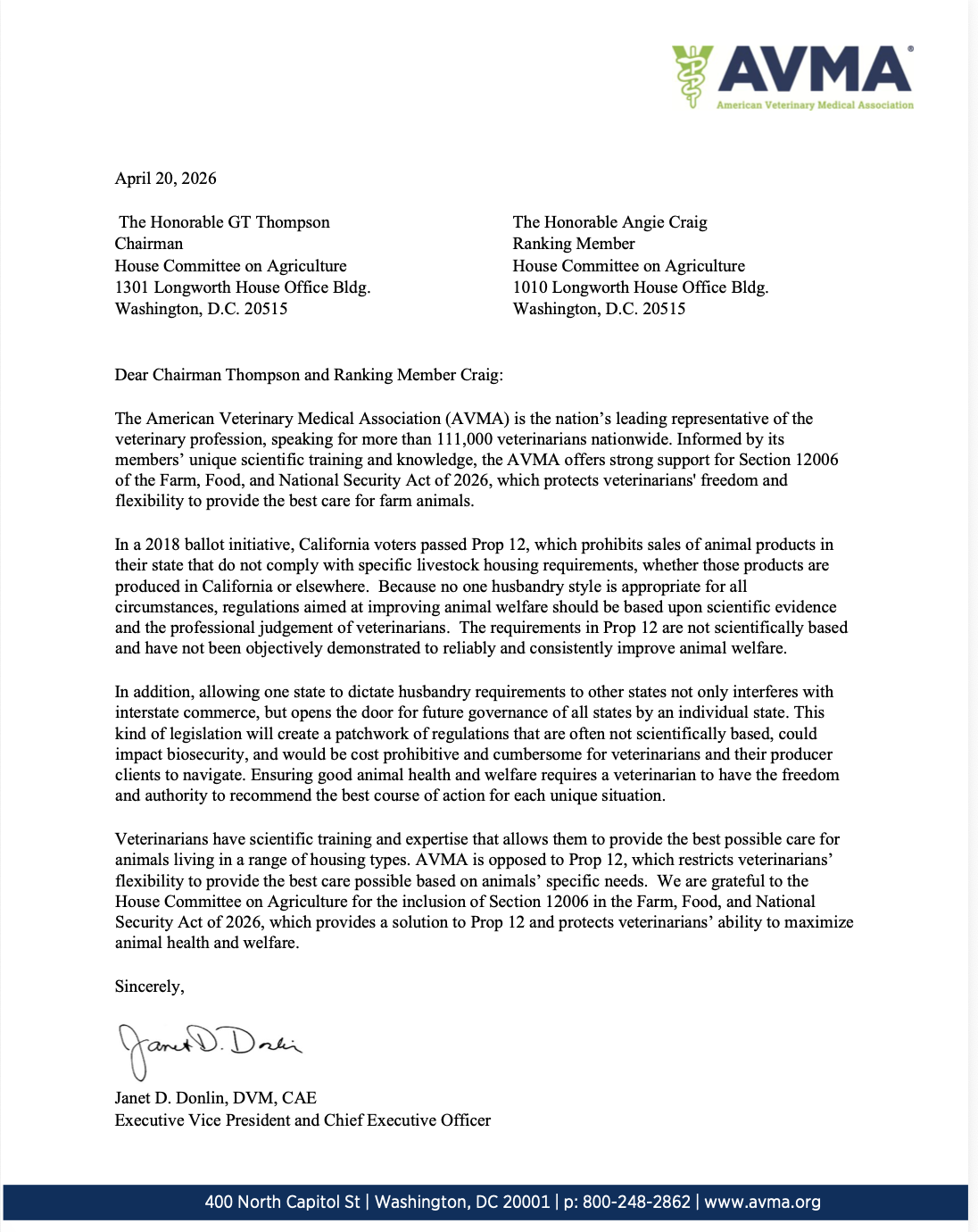
We are deeply disappointed that the AVMA continues to ignore the will of its members and support language that ignores the evidence described in the letter above.
Below is their April 20, 2026, letter to the House Committee on Agriculture.