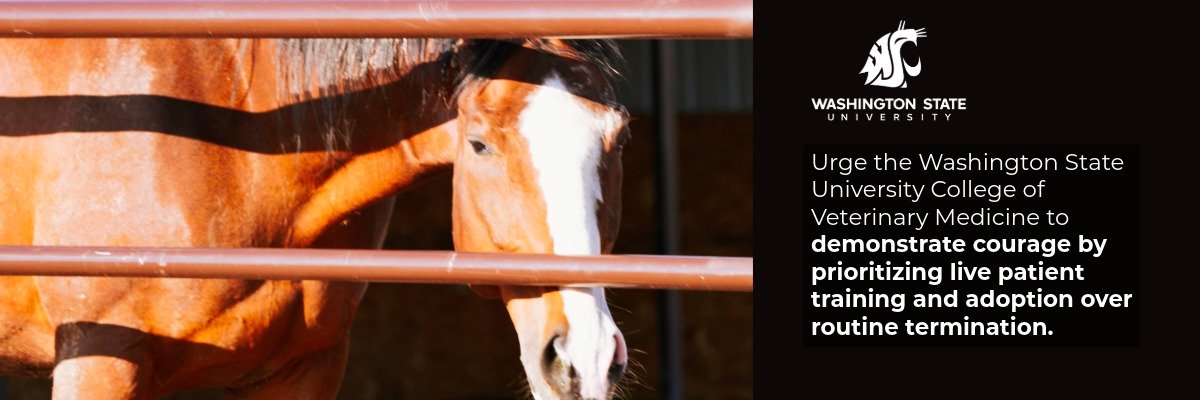
Urge Washington State to prioritize teaching practices to align with those recommended by the AAVMC
Dori Borjesson, DVM, MPVM, PhD
Dean, WSU College of Veterinary Medicine
Professor, Department of Veterinary Microbiology and Pathology
College Administration
WSU College of Veterinary Medicine
110K Bustad Hall
Pullman, WA 99164
509-335-9515
509-335-3064
dori.borjesson@wsu.edu
Dear Dr. Dori Borjesson,
We know effective veterinary student education is important to the Washington State University College of Veterinary Medicine. We hope to meet with you to discuss how we might help Washington State improve the current classes that involve the unnecessary killing of healthy animals for student education. We believe graduating students should be confident practitioners and surgeons. This means giving them ample opportunity for live tissue handling and post-anesthesia recovery—skills best obtained on patients who need procedures under the guidance of experienced veterinarians.
Our paper, “A Public Records Review of Cadaver and Terminal Animal Use in U.S. and Canadian Veterinary Schools,” was recently published in the Journal of Veterinary Medical Education.
We reviewed animal use protocols from nearly every public veterinary school in the United States and Canada, including Washington State. We evaluated the degree to which protocols adhered to the AAVMC Guidelines for the Use of Animals in Veterinary Education, which, as you know, recommend best practices for the use of animals in teaching. In particular, the AAVMC Guidelines stress using animals in ways that minimize harm while achieving student learning outcomes. For example, cadavers should be sourced ethically and humanely, alternatives to animals should be considered whenever possible, and teaching policies should emphasize that invasive procedures only be performed when there is a clear medical benefit to the animal.
Among the records we obtained from Washington State University were the following protocols:
· Gross Anatomy Teaching Protocol (VM 511, 512, 518, V Ph 308): This protocol is for teaching anatomy to veterinary students. This protocol requests up to 25 dogs, 13 horses, 4 cows, and 5 goats. Dogs and horses may be donated or transferred from other protocols. Cows and goats may be surplus from other protocols or acquired from other sources.
· Small Animal Applied Anatomy (VM 517): This protocol is for teaching cadaver dissection, case studies, and examination of specimens and imaging to veterinary students. Up to 80 dog cadavers are used per year. Some animals may be donated, while the rest are animals transferred from other protocols and slated for euthanasia. This course was unique among the protocols we received, and it may be that 80 fresh cadavers are not necessary for this course.
· Worthman Museum and CVM Anatomy Teaching: This protocol is for creating teaching specimens that are available for use in veterinary student courses and displayed to the public in the Worthman Anatomy Teaching Museum. This protocol requests cats, dogs, sheep, goats, alpacas, horses, cows, and pigs. Cats and dogs may be donated or transferred from other protocols. Other animals are surplus animals transferred from other protocols or acquired from other sources and do not seem to be euthanized due to medical reasons.
· Advanced Equine Surgery Elective (VM 638P): This protocol is for teaching procedures and surgical techniques to vet students, residents, and faculty. Up to 10 horses per year are requested, although it seems that not all will be used in terminal teaching procedures. Horses are donated or from the university herd. It is unclear if the horses from the university heard are slated for medical euthanasia. The AAVMC Guidelines do not recommend terminal surgeries as a method of teaching, even using donated animals.
· Ruminant Surgery Elective Lab (VM 573P): This protocol is for teaching surgeries and procedures to vet students. This protocol requests up to 14 goats per year. Pregnant does will undergo cesarean sections – if the kids are premature, they and the doe will be killed; if the kids are viable, they and the doe will be recovered. All other goats undergo terminal surgeries. Goats are purchased and appear to be otherwise healthy.
· Advanced Theriogenology (VM 632P): This protocol is for teaching reproductive techniques, including surgeries, which are terminal to vet students. Up to 19 sheep and/or goats are requested annually. Some are donated, and some are purchased or transferred from other protocols. At least some are cull animals but not necessarily for medical reasons.
· Superovulation, artificial insemination, and embryo collection in sheep and goats: This protocol is for teaching vet students laparoscopic reproductive surgery techniques, most of which are terminal. Up to 8 sheep and/or goats are killed annually. Animals may be donated, purchased, or transferred from other protocols. Some or all maybe be cull animals, but not necessarily for medical reasons.
· VM 573P LA Junior Surgery: This protocol is for teaching anatomy, surgery and anesthesia to vet students. Up to 60 goats or sheep and 8 horses are requested for these terminal labs. Goats and sheep are purchased and appear to be otherwise healthy, horses are donated, purchased, or transferred from internal protocols.
We understand that in a few weeks, 8 horses from the USDA Research program will have their lives ended in a terminal laboratory. We urge you to stop this class and allow these horses to live out the rest of their lives in a sanctuary. Such a retirement would model responsible animal stewardship.
In evaluating animal use protocols from veterinary schools, we were impressed by the innovative and effective programs that schools have developed for teaching veterinary students, residents, and interns. These include programs that prioritize access to care by allowing students to perform medically necessary procedures on animals under the supervision of experienced instructors, robust willed-body programs, providing care to farmed animal sanctuaries, low- or no-cost castration clinics for horses, and providing services for farmed animal producers. We also saw many examples of schools integrating effective instructional tools, such as manikins, simulators, low- and high-fidelity models, and software, to enhance student learning as recommended by the AAVMC. The AAVMC Use of Animals in Veterinary Education Handbook provides an in-depth review of the benefits of these teaching methods, as well as practical advice on implementing them in veterinary school curricula.
We recognize that animals must be used in veterinary education; it is imperative that schools use them effectively while protecting our profession’s reputation as courageous advocates for animals. As a leader in veterinary education, your institution has a duty to uphold the highest standards of effective animal use, not only in practice but also in the training of future veterinarians. Therefore, we urge you to prioritize transitioning your schools’ teaching practices to align with the AAVMC's recommendations. We would welcome the chance to discuss this with you.
Thank you for your time and thoughtful consideration of this matter. We believe that by embracing these effective changes, you will excel in training courageous, skilled, and confident veterinarians for the future.
Sincerely,
Crystal Heath, DVM
Erin Zamzow DVM
Kathryn Strickland, DVM
Donna Kelleher, DVM
Monica Ramirez, DVM
Lucy Hurlock, VMD
Brenda Forsythe, PhD, DVM
Hannah Mueller DVM
Jeff Blake, DVM
Heather Woodke, DVM, MA
Kirsten Jackson BSc BVMS (hons), PhD, MANZCVS (equine dentistry)
Joanne Connolly DVM
Jena Questen DVM CertAqV
Meghan Shannon DVM
Kathy Strickland DVM
Joseph Eastman PhD
Ruta Soltanpour, CCA
Periel Stanfield
Kathy McNamara
Kate Madden
Omar Gerardo
Barbara Berger
James Wagner
Omar Gerardo
Ellen Kessler
Periel Stanfield
Trish Marie
Kedar Tembe
Matthew Leonard
Cynthia Brast
Calie Blanke
Cher L Renke-VanHoecke
Aline Rahm
Christina L. Dominguez
Symone Douglas
Phung Nguyen
Kaeden Rahm
Antonio Diaz
Romy de Courtay
Amanda Upshaw
Stephanie Yellin, DO
Amanda Winchester
Justin Taylor
Jodey Castricano, PhD, FOCAE
Samuel Baca-Henry
Mireia Ravell
Vivienne Green
Alana Peake
Sign onto the Letter
