Veterinarians For An Egg Free Future
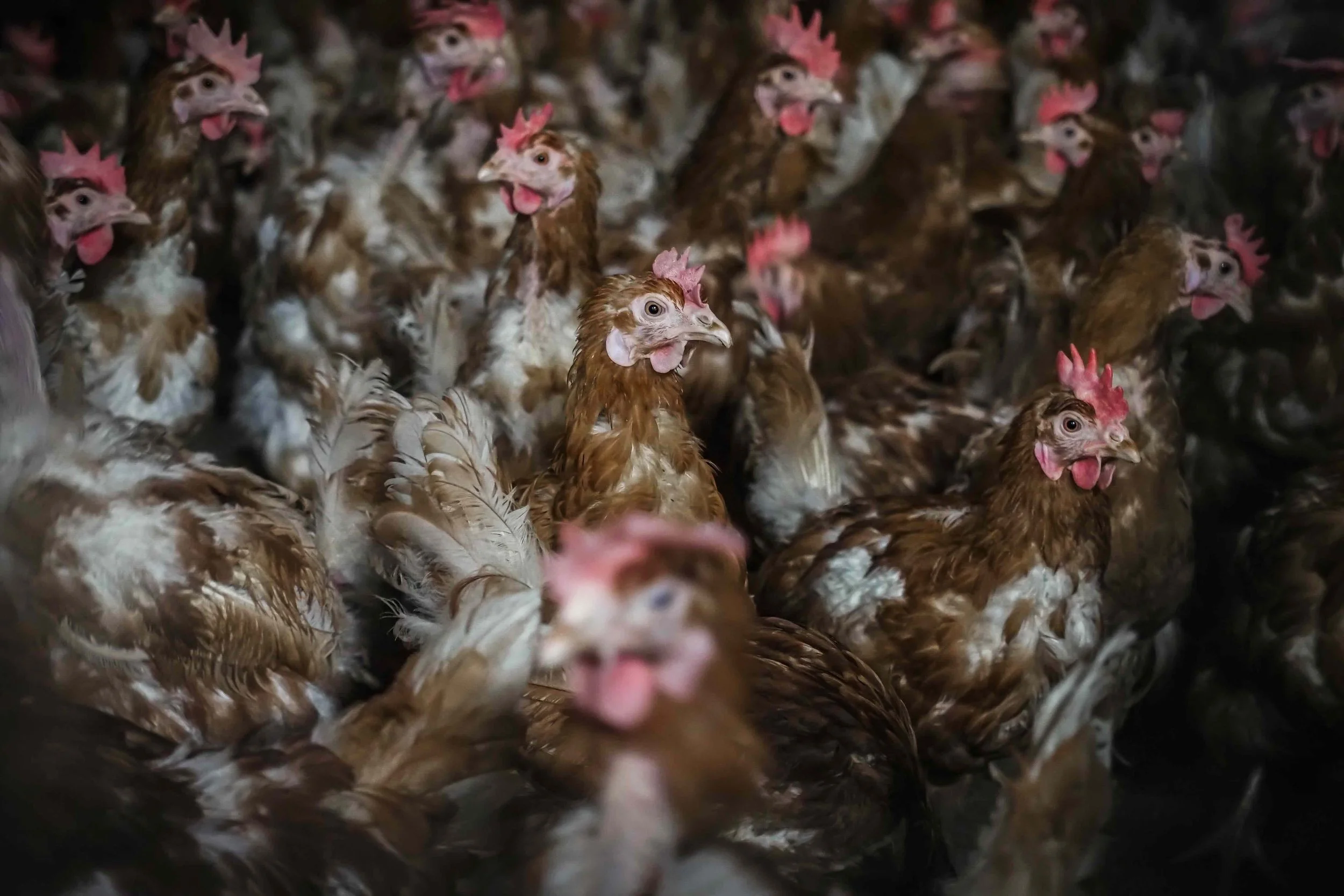
Laying hens stand in crowded conditions inside an aviary system at a Czech facility. Czechia, 2021. Lukas Vincour / Zvirata Nejime / We Animals
Why veterinarians are calling for corporate egg-free commitments
Download free flyers for your clinic here
Download the social media graphic
Veterinarians are trained to evaluate how disease spreads, how food is produced, how environmental contamination accumulates, and how these factors ultimately affect human health. That systems-level training is why a growing number of veterinarians are now uniting behind a clear and evidence-based position: an egg-free food system is one of the fastest, most effective ways to protect animals, public health, and our food security.
Veterinarians For An Egg-Free Future is a campaign supporting corporate commitments to remove eggs from products, ingredient lists, and menus, and to replace them with more resilient animal-free alternatives. We aim to make high-protein, whole-foods, animal-free meals ubiquitous, affordable, and normal.
Egg-free is a structural upgrade to a food system that has become fragile, risky, and increasingly expensive.
Cage-free was sold as reform. It became a revenue stream.
Over the past decade, cage-free egg campaigns were marketed as a major welfare breakthrough. In reality, they preserved the same industrial production model while increasing disease risk, environmental contamination, and bird injury.
The data show:
Between 85 and 97 percent of hens in non-cage systems suffer keel bone fractures, a painful injury caused by collisions, falls, and chronic pressure on their bodies.
Feather pecking occurs in 80 to 94 percent of cage-free flocks in the United States, resulting in open wounds, infections, and cannibalism.
Ammonia emissions in cage-free systems are approximately 19 percent higher than in conventional cages, worsening respiratory disease and environmental pollution.
Dust levels are five to fifteen times higher in cage-free facilities, damaging lungs, spreading pathogens, and increasing worker exposure.
Cage-free converts one large industrial shed into a single massive cage containing tens of thousands of birds breathing shared air, walking on shared feces, and subjected to constant stress and injury.
Yet cage-free labeling has dramatically increased consumer confidence in eggs. When eggs are a trusted product, people buy more of them. That increased demand translates into more birds, greater disease pressure, and higher profits for multi-billion dollar corporations.
Cage-free has protected the egg industry’s public image. It has not protected hens.
Egg-free protects food security
Eggs are one of the most unstable ingredients in the modern food system. Their price swings wildly due to corporate hoarding, disease outbreaks, flock depopulations, and trade disruptions. A single wave of avian influenza can wipe out millions of birds and destabilize entire supply chains.
Animal-free egg replacements do not carry those risks. They rely on shelf-stable proteins, starches, fibers, and fermentation-derived binders that can be produced at scale without live animals. They are not vulnerable to quarantines, mass culling, or biosecurity shutdowns.
Removing eggs from products immediately increases food system resilience. It lowers price volatility, reduces supply disruptions, and insulates manufacturers and consumers from the repeated shocks caused by poultry disease outbreaks.
Food security is about reliability, which only egg-free ingredients can deliver.
Egg-free limits virus propagation
From a veterinary and public-health perspective, eggs are part of a biological system that repeatedly generates global disease threats.
High-density poultry barns are ideal environments for viruses to spread, mutate, and reassort. Research from the Harvard T.H. Chan School of Public Health, led by Dr. Aaron Bernstein, shows that by addressing the causes of pandemics we can not only save billions of dollars, but lives as well. “high-density livestock operations can serve as an opportune environment for spillover from wild animals into livestock or as incubators for pandemic influenza strains ... Large pig and poultry farms are where the genetic re-assortment needed to source pandemic influenza strains may most likely occur.”
Sinel and Weis similarly warn in a recent paper, “Infectious disease experts have long warned that the next pandemic could well emerge from a virulent new variant of avian or swine influenza spilling over into a human population and becoming transmissible through human-to-human contact.”
Reducing egg production reduces the number of birds, the size of flocks, and the amount of viral traffic moving through them. That is not symbolic. It is a direct, measurable reduction in pandemic risk.
Egg-free is biosecurity.
Egg-free supports resilient food producers
Egg-free reform is often portrayed as a threat to producers, but in reality, it offers an exit from one of the most unstable sectors in agriculture.
Animal-free proteins and functional ingredients can be produced by a wider range of growers and processors, in more geographic regions, with far less risk of catastrophic loss. They do not require constant live-animal turnover, massive waste handling, or the biosecurity infrastructure that makes poultry farming so precarious.
An egg-free food system shifts economic power away from disease-prone mega-farms and toward diversified, regional ingredient producers. That diversification is what makes food systems resilient.
Egg-free is economically feasible right now
Companies do not need future technology to go egg-free. The ingredients already exist, and in many cases they are cheaper than eggs.
Eggs are expensive because they require feed, housing, labor, disease control, waste management, and constant flock replacement. Every outbreak pushes those costs higher.
Animal-free egg replacements avoid those liabilities. They provide predictable pricing, long shelf life, and consistent performance in baking, sauces, dressings, and prepared foods. Many companies that have switched report lower ingredient costs and greater supply stability.
There is also a major market expansion effect. Egg-free products can be sold to people who do not consume eggs for health, allergy, religious, or ethical reasons. Reformulating once allows companies to serve millions of additional customers without losing their existing base.
Egg-free is not a niche strategy. It is a growth strategy.
Why veterinarians are leading this shift
Veterinarians see the injuries inside cage-free buildings. We see the broken bones, the chronic wounds, and the respiratory disease. We also track the epidemiology. We follow how viruses circulate through crowded flocks and how outbreaks spread across regions and species.
Our job is to prevent suffering and prevent disease. Egg-free does both.
Cage-free was presented as progress. In practice, it locked us into a high-risk production model while protecting corporate profits and nonprofit fundraising campaigns built around incremental reform.
Egg-free changes the system instead of rearranging it.
That is why Veterinarians For An Egg-Free Future exists. We are calling on corporations to stop debating how to house hens slightly differently and start asking how to make eggs unnecessary.
A food system built on high-protein, whole-foods, animal-free ingredients is safer, more stable, and more economically rational.
