Request AVMA Delegates to Support Policy for Increased Snake Enclosure Size
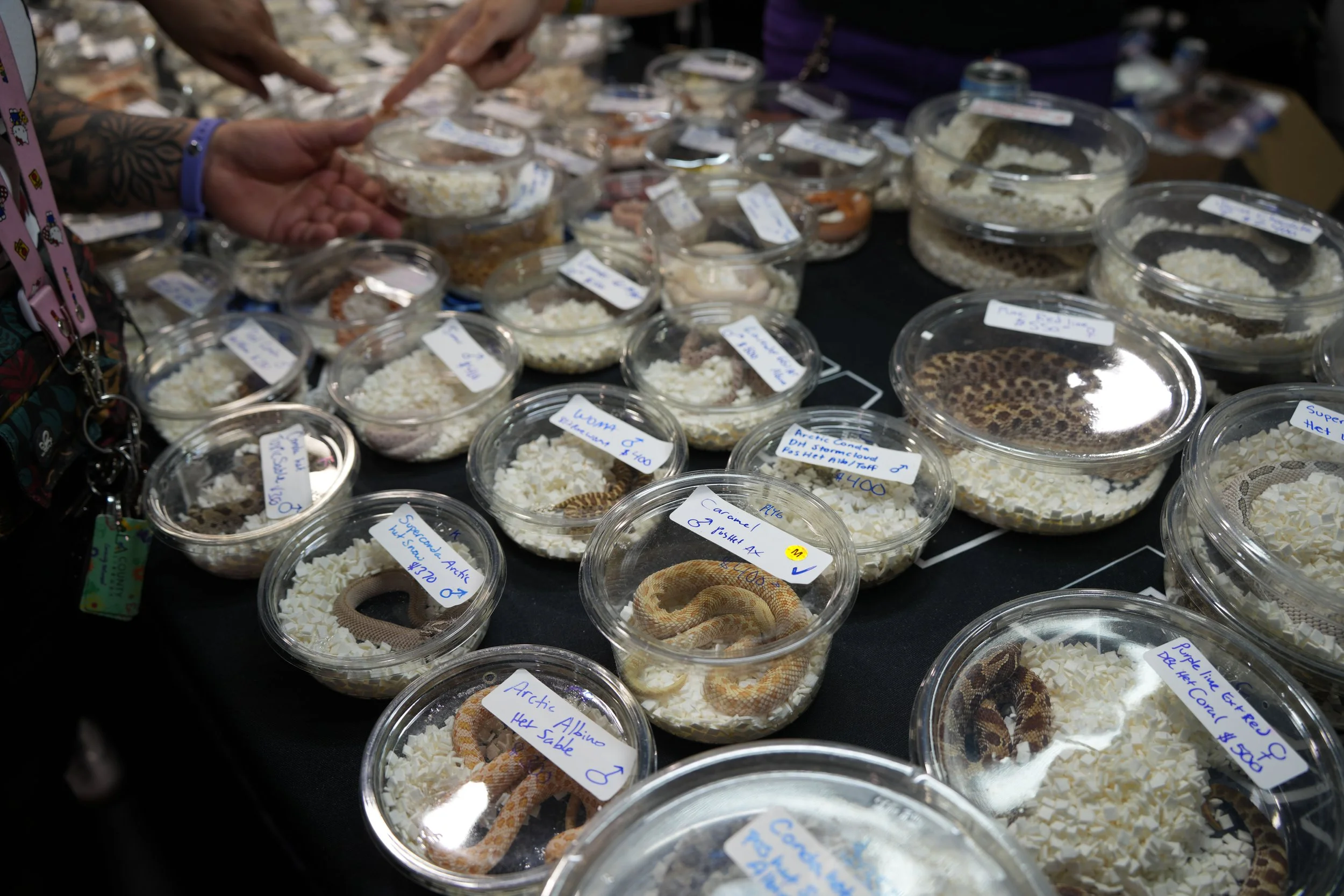
Snakes for sale at a reptile show in California. Photo Credit: Dr. Crystal Heath, DVM
As a veterinary advocacy organization, we believe that meaningful change within the AVMA is driven by its members. Delegates, state VMAs, and local VMAs are responsive to the veterinarians they represent, and direct engagement is one of the most effective ways to influence the culture and policy direction of our profession. Sharing your perspective with your delegates and professional associations is how institutional change occurs. For this reason, we encourage all veterinarians, including those who are deeply critical of the AVMA, to remain engaged and make their views known. You are welcome to copy and paste the letter below to send to your representatives, and to sign in solidarity with others calling for the AVMA to uphold the standards and commitments of the veterinary oath.
Sign into AVMA.org to find the contact information for your delegates.
Dear [Delegate’s Name],
I am writing as a member of the American Veterinary Medical Association (AVMA) to respectfully urge you to support the adoption of a formal AVMA policy opposing the housing of snakes in enclosures that do not allow them to fully extend their bodies.
A growing body of peer-reviewed scientific literature (see References) demonstrates that enclosures which prevent snakes from stretching to their full length are inconsistent with evidence-based husbandry standards and compromise animal welfare. The ability to assume a straight-line body posture is not a luxury but a fundamental biological and behavioral need. Restrictive enclosures have been linked to a wide range of physical and behavioral issues, and there is no credible scientific evidence supporting enclosure sizes that fall below this minimum standard.
Despite this consensus, the practice of housing snakes in undersized enclosures remains widespread. Guidance from commercial sellers is often inconsistent with veterinary recommendations, and many state regulations either lack specificity or permit enclosure dimensions that do not meet even the minimum requirement of accommodating full body extension. The Animal Welfare Act requires that animals be provided with “adequate space,” however, it does not establish species-specific enclosure standards for snakes, leaving a critical regulatory gap that fails to ensure they can fully extend their bodies in accordance with current scientific welfare recommendations.
At the same time, there are encouraging signs of progress. Veterinary organizations and industry stakeholders are beginning to recognize the importance of adequate space for snakes, and some jurisdictions have started to incorporate these standards into regulation. This makes the present moment especially important for the AVMA to provide clear, science-based leadership on this issue.
I respectfully request that the AVMA Animal Welfare Committee consider adopting a policy stating that:
Terrestrial snakes should be housed in enclosures with a minimum length equal to the snake’s full body length.
Arboreal snakes should be housed in enclosures that allow full extension in all three dimensions (length, width, and height).
Such a policy would align the AVMA with current scientific understanding, reinforce its commitment to evidence-based animal welfare, and help guide veterinarians, policymakers, and the public toward more humane and appropriate standards of care.
Thank you for your time and consideration of this important issue.
Sincerely,[Your Name], [Your Credentials]
AVMA Number:[Your Contact Information]
References
Arena, P.C. & Warwick, C. (2023). Spatial and thermal factors. In C. Warwick, P.C. Arena, & S. Steedman (Eds.), Health and Welfare of Captive Reptiles (2nd ed., pp. 417, 425, 429–430). Springer. https://link.springer.com/book/10.1007/978-3-030-86012-7
Barten, S.L. & Fleming, G.J. (2014). Current herpetologic husbandry and products. In D.R. Mader & S.J. Divers (Eds.), Current Therapy in Reptile Medicine and Surgery (pp. 2–12). Elsevier. https://veteriankey.com/current-herpetologic-husbandry-and-products/
British Veterinary Association. (n.d.). Think twice: Is this pet right for you? https://www.bva.co.uk/take-action/our-policies/exotic-pets-non-traditional-companion-animals
British Small Animal Veterinary Association. (2023, July 14). Pet snakes in the UK – World Snake Day. https://www.bsava.com/article/pet-snakes-in-the-uk-world-snake-day/
Cargill, B.M., et al. (2022). A survey exploring the impact of housing and husbandry on pet snake welfare. Animal Welfare, 193. https://www.cambridge.org/core/services/aop-cambridge-core/content/view/7BED1DBAF7E7736788E3DEDAAC2A352D/S0962728600009969a.pdf/a-survey-exploring-the-impact-of-housing-and-husbandry-on-pet-snake-welfare.pdf
Colorado Department of Agriculture. (2025, June). Snake enclosure rule. 48 Colo. Reg. 754, 774; 8 Colo. Code Regs. § 1202-15:12.11.15 (effective July 15, 2025).
D’Cruze, N., et al. (2020). Dropping the ball? The welfare of ball pythons traded in the EU and North America. Animals, 10(3), 413. https://www.mdpi.com/2076-2615/10/3/413
Hollandt, T., et al. (2021). Animal-appropriate housing of ball pythons (Python regius)—behavior-based evaluation of two types of housing systems. PLOS ONE, 16. https://journals.plos.org/plosone/article?id=10.1371/journal.pone.0247082
Hutchings, J. & Crane, M. (2025). Recent scientific insights into the spatial needs of captive snakes. International Journal of Zoology, 5. https://onlinelibrary.wiley.com/doi/epdf/10.1155/ijz/3548045
Jepson, L. (2015). Inspecting pet shops. In Practice, 37, 333–343. https://bvajournals.onlinelibrary.wiley.com/doi/epdf/10.1136/inp.h3396
Jessop, M., et al. (2023). Evidential thresholds for species suitability in captivity. In C. Warwick, P.C. Arena, & S. Steedman (Eds.), Health and Welfare of Captive Reptiles (2nd ed., p. 509, 514). Springer. https://link.springer.com/book/10.1007/978-3-030-86012-7
Mendyk, R.W. & Warwick, C. (2023). Arbitrary husbandry practices and misconceptions. In C. Warwick, P.C. Arena, & S. Steedman (Eds.), Health and Welfare of Captive Reptiles (2nd ed., pp. 561–582). Springer. https://link.springer.com/book/10.1007/978-3-030-86012-7
Petco. (2025, May 22). Choosing the right reptile for you. https://www.petco.com/content/content-hub/home/articlePages/new-pet/Caring-for-Pet-Reptiles.html
Rossi, J.V. (2019). General husbandry and management. In S.J. Divers & S.J. Stahl (Eds.), Mader’s Reptile and Amphibian Medicine and Surgery (pp. 109, 118–123). Elsevier. https://www.sciencedirect.com/science/article/abs/pii/B9780323482530000167
Showalter, R. (2021, June 21). Central Coast reptile supplier removes snake-care guidance after PETA lawsuit. KCBX. https://www.kcbx.org/pets-animals/2021-06-21/central-coast-reptile-supplier-removes-snake-care-guidance-after-peta-lawsuit
Spain, M.S., et al. (2020). Effects of habitat modifications on behavioral indicators of welfare for Madagascar giant hognose snakes (Leioheterodon madagascariensis). Animal Behaviour and Cognition, 7, 70–81. https://www.researchgate.net/publication/338982217_Effects_of_Habitat_Modifications_on_Behavioral_Indicators_of_Welfare_for_Madagascar_Giant_Hognose_Snakes_Leioheterodon_madagascariensis
UK Animal Welfare Committee. (2023, June 5). Opinion on the space requirements for snakes in vivaria within pet selling establishments. https://assets.publishing.service.gov.uk/media/647dc7c35f7bb700127fa45c/AWC_opinion_space_snakes_vivaria_pet_selling_establishments.pdf
Warwick, C. (1990). Reptilian ethology in captivity: Observations of some problems and evaluation of their aetiology. Applied Animal Behaviour Science, 26(3–4). https://www.sciencedirect.com/journal/applied-animal-behaviour-science/vol/26/issue/1
Warwick, C. (2023). Psychological and behavioral principles and problems. In C. Warwick, P.C. Arena, & S. Steedman (Eds.), Health and Welfare of Captive Reptiles (2nd ed., pp. 239, 267–268). Springer. https://link.springer.com/book/10.1007/978-3-030-86012-7
Warwick, C. & Steedman, C. (2023). Naturalistic versus unnaturalistic environments. In C. Warwick, P.C. Arena, & S. Steedman (Eds.), Health and Welfare of Captive Reptiles (2nd ed., pp. 487–508). Springer. https://link.springer.com/book/10.1007/978-3-030-86012-7
Warwick, C., et al. (2013). Assessing reptile welfare using behavioural criteria. In Practice, 35, 123–131. https://bvajournals.onlinelibrary.wiley.com/doi/epdf/10.1136/inp.f1197
Warwick, C., et al. (2019). Spatial considerations for captive snakes. Journal of Veterinary Behavior, 30, 37–47. https://www.sciencedirect.com/science/article/pii/S1558787818302211
Warwick, C., et al. (2021). Getting it straight: Accommodating rectilinear behavior in captive snakes—a review of recommendations and their evidence base. Animals, 11(5), 1459. https://www.mdpi.com/2076-2615/11/5/1459
Warwick, C., et al. (2024). Reptile expos: An analysis and recommendations for control. Frontiers in Animal Science, 7. https://www.frontiersin.org/journals/animal-science/articles/10.3389/fanim.2024.1335982/full
Warwick, C. (2024, September 25). Letter to Brandon J. DeCuir, Chairman, Louisiana Wildlife & Fisheries Commission. On file with PETA.
