New Public Records Reveal California’s bird-flu response: movement warnings, testing delays, disposal, and scrutiny of the press
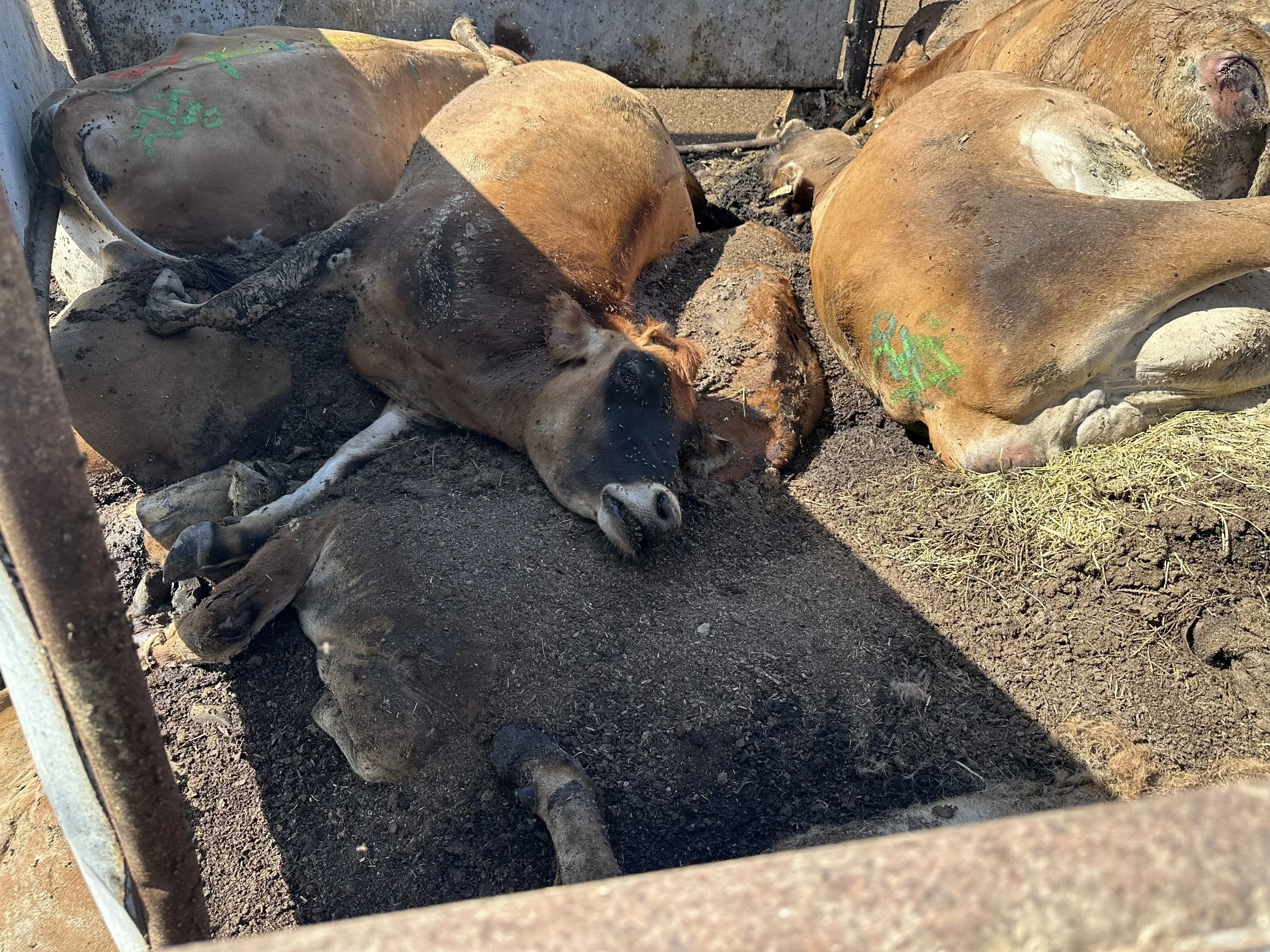
The first photos published of dairy cows who were confirmed to have died of H5N1.
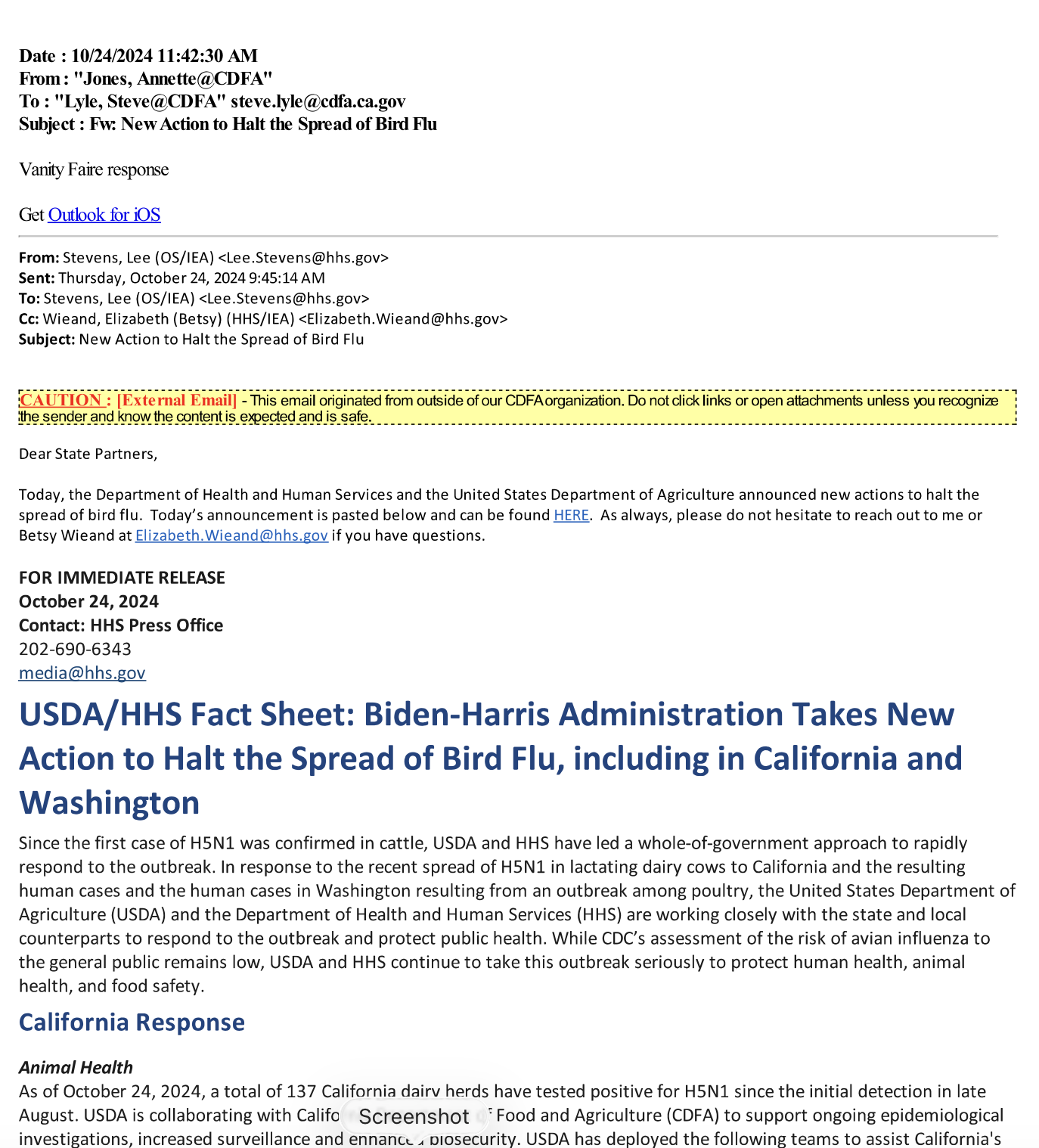
A newly released set of California Department of Food and Agriculture (CDFA) emails captures a difficult stretch of the state’s October 2024 H5N1 response. Officials were trying to trace infections among dairies and poultry facilities, process a growing number of samples, quarantine exposed flocks, and decide how to dispose of birds whose lives were ended. They also tracked the tone and reach of news coverage and responded to reporters asking what was happening on the ground.
The first 268 pages released in response to my Public Records Act request contain specific warnings and decisions. CDFA says more records will follow.
A warning about poultry movement
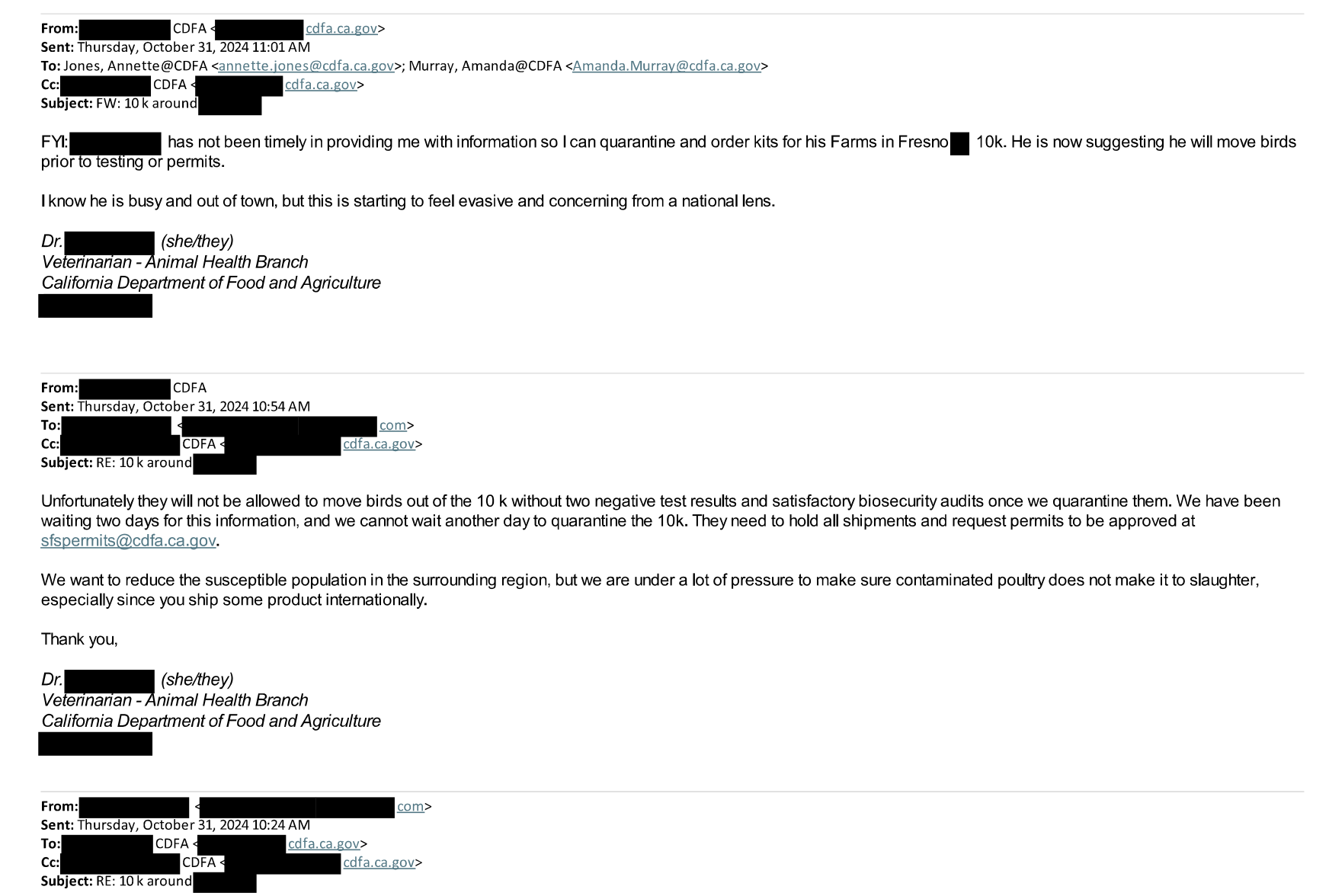
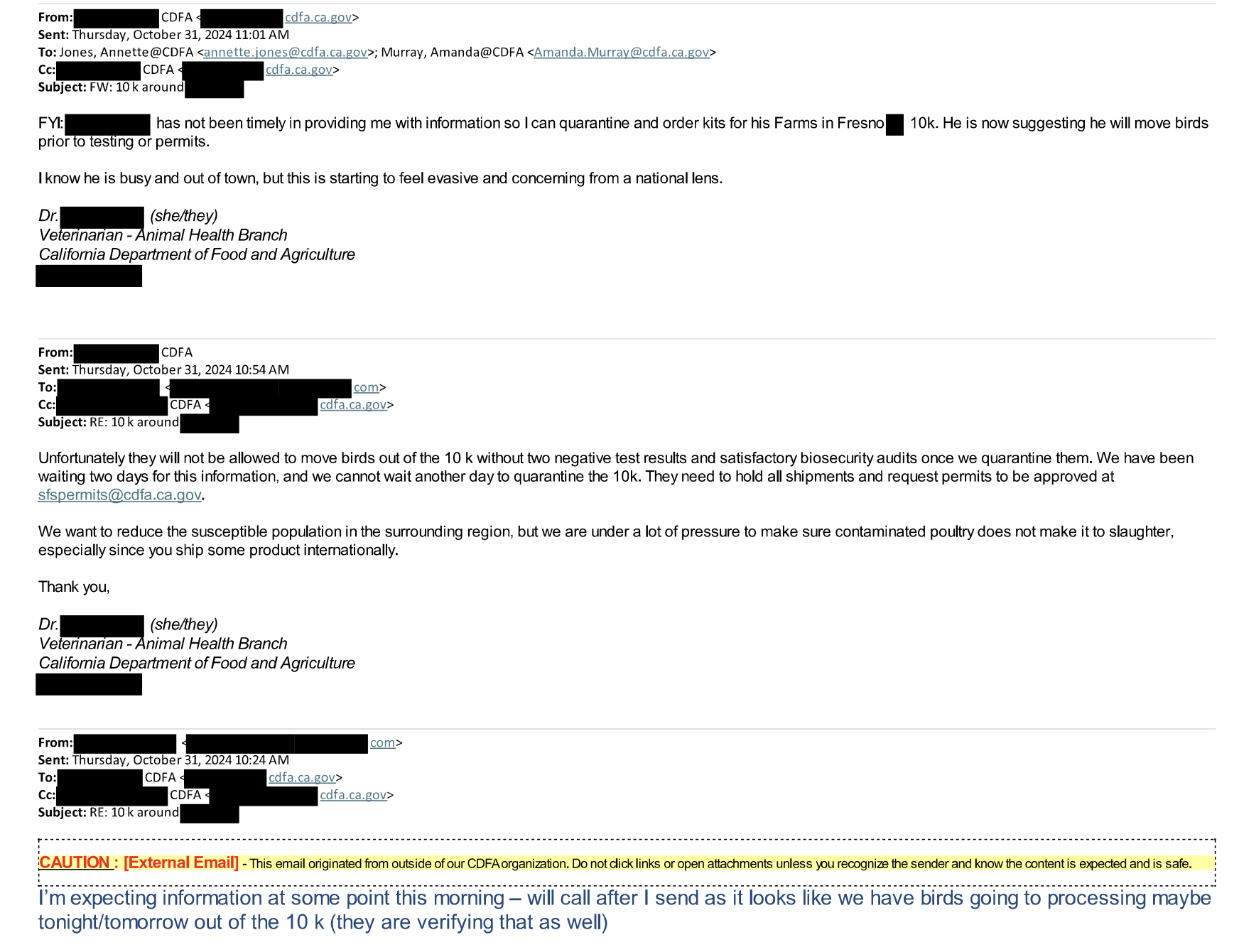
One urgent exchange is dated October 31. A CDFA veterinarian told colleagues that a producer had not promptly supplied the information needed to quarantine farms within 10 kilometers of an infected poultry premises and suggested birds might move before testing or permits. An earlier message from the producer said birds might be scheduled for processing that night or the following day, pending verification. Another official instructed the producer to hold shipments and said birds could not leave the 10-kilometer zone after quarantine without two negative tests and satisfactory biosecurity audits. State veterinarian Annette Jones directed staff to deliver the quarantines. A colleague acknowledged having failed to follow up after a conversation the previous night. (Bates 000140–000141.)
While the emails show officials were worried that birds might be moved before testing and permits were in place, they don’t tell us whether any birds actually left, whether they were infected, or whether they reached slaughter or export. To find out what happened, we need the permits, test results, quarantine records, and processor records.
Some dairy producers reported weeklong waits for test results
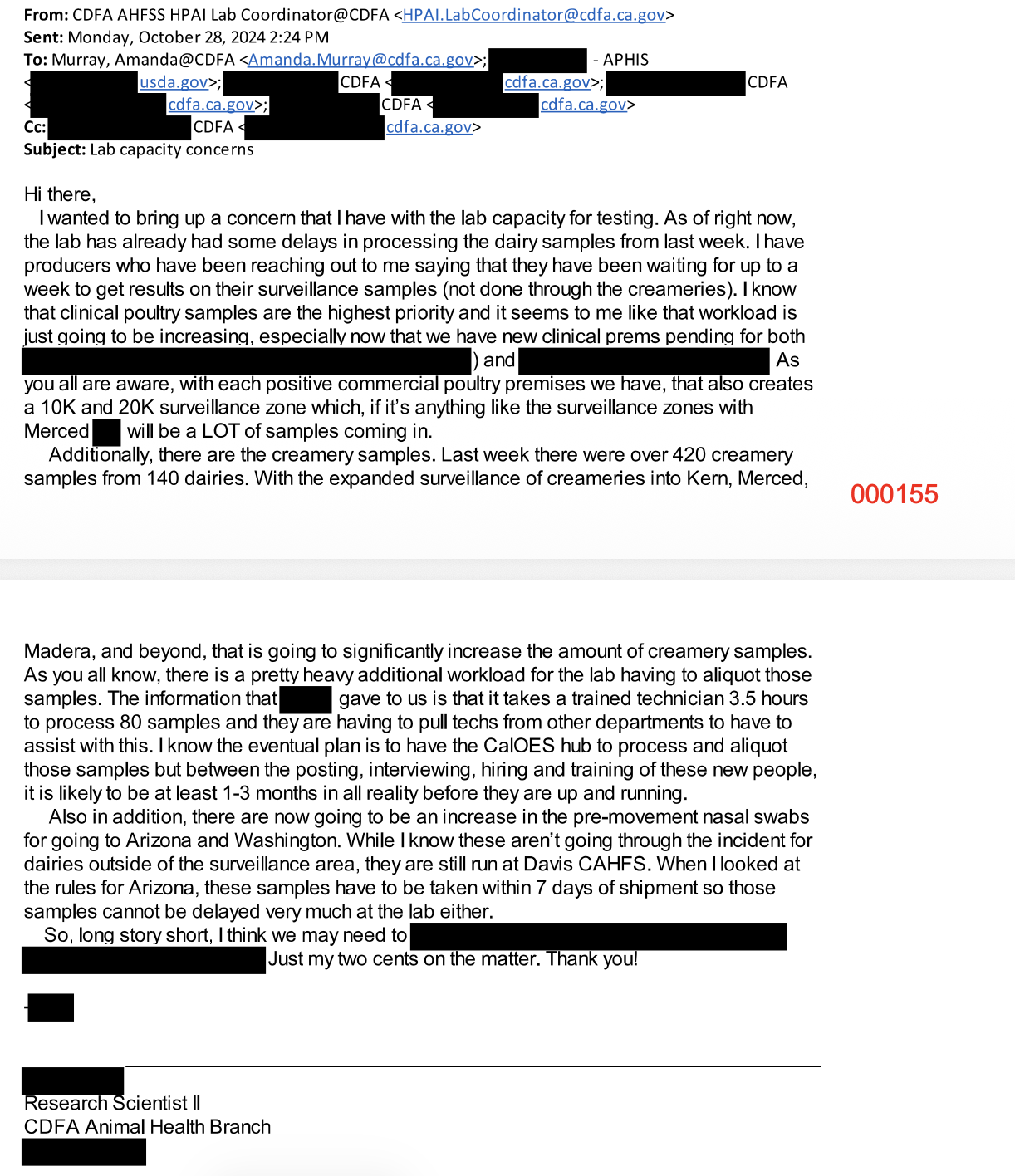
By late October, the volume of bird-flu samples was straining California’s testing system. On October 28, a CDFA laboratory coordinator wrote that some dairy producers said they had waited up to a week for results from surveillance samples outside the creamery program. More than 420 separate creamery samples from 140 dairies had arrived the previous week, with additional poultry surveillance and cattle-movement testing expected. The coordinator estimated that a proposed sample-processing hub might take one to three months to staff and train. A UC Davis correspondent acknowledged bottlenecks in receiving and preparing samples, while officials discussed sending some work to other laboratories, including Cornell. (000154–000156.) Sample submission and result timestamps would show how common the delays were and whether the changes helped.
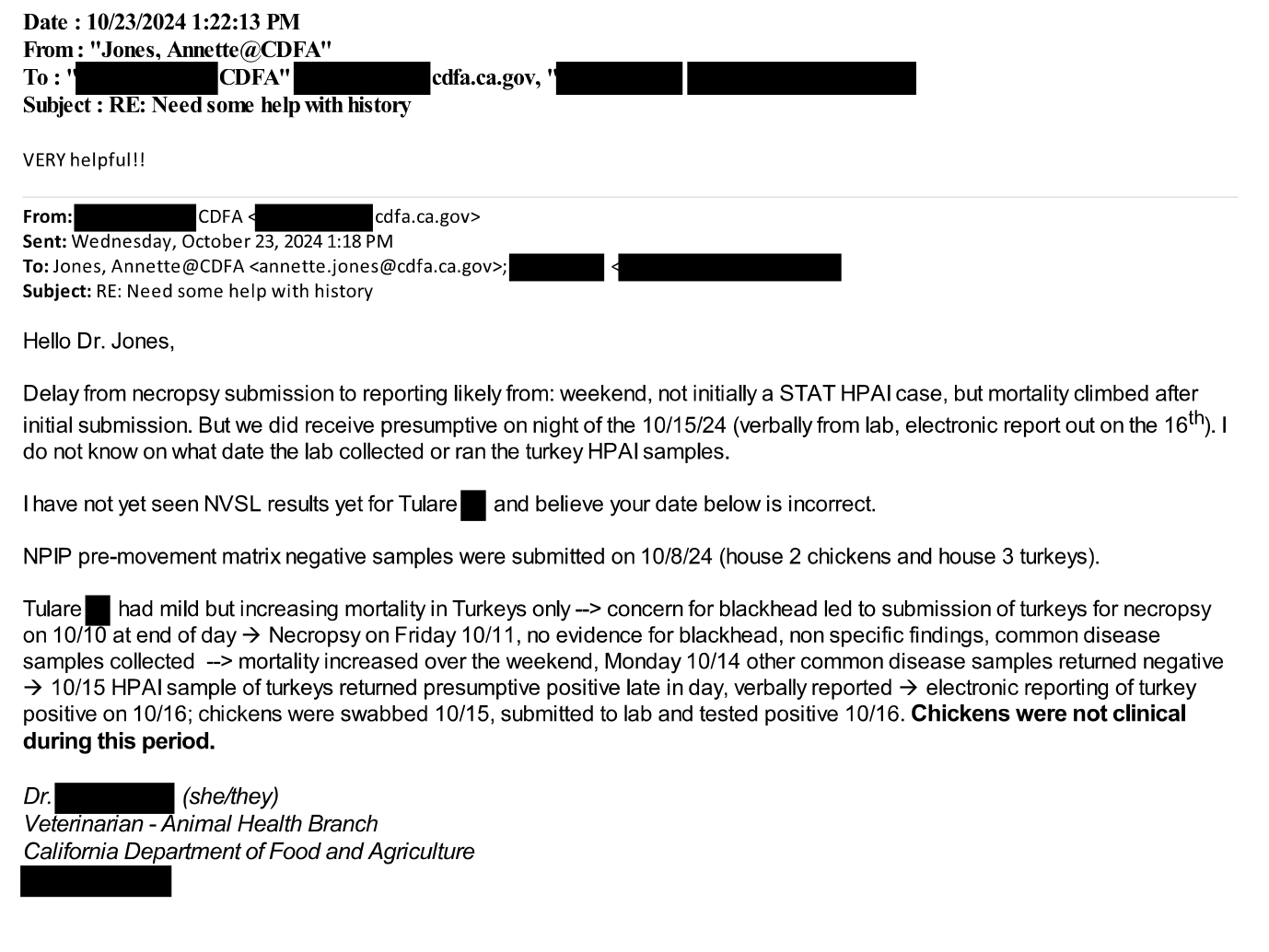
Another email traces how officials identified H5N1 at a Tulare poultry facility.Turkeys with rising mortality were submitted for necropsy on October 10 because blackhead disease was suspected. Findings the next day were nonspecific. As mortality increased and tests for other common diseases came back negative, a turkey HPAI sample was reported presumptively positive on October 15th. Chickens on the premises tested positive October 16th but showed no clinical signs. (000169.) The author of the chronology said they did not know when the laboratory collected or ran the turkey HPAI sample. The exchange therefore explains the recorded sequence; it does not establish when the birds first became infected or prove a laboratory error.
How CDFA responded to footage of roadside carcasses
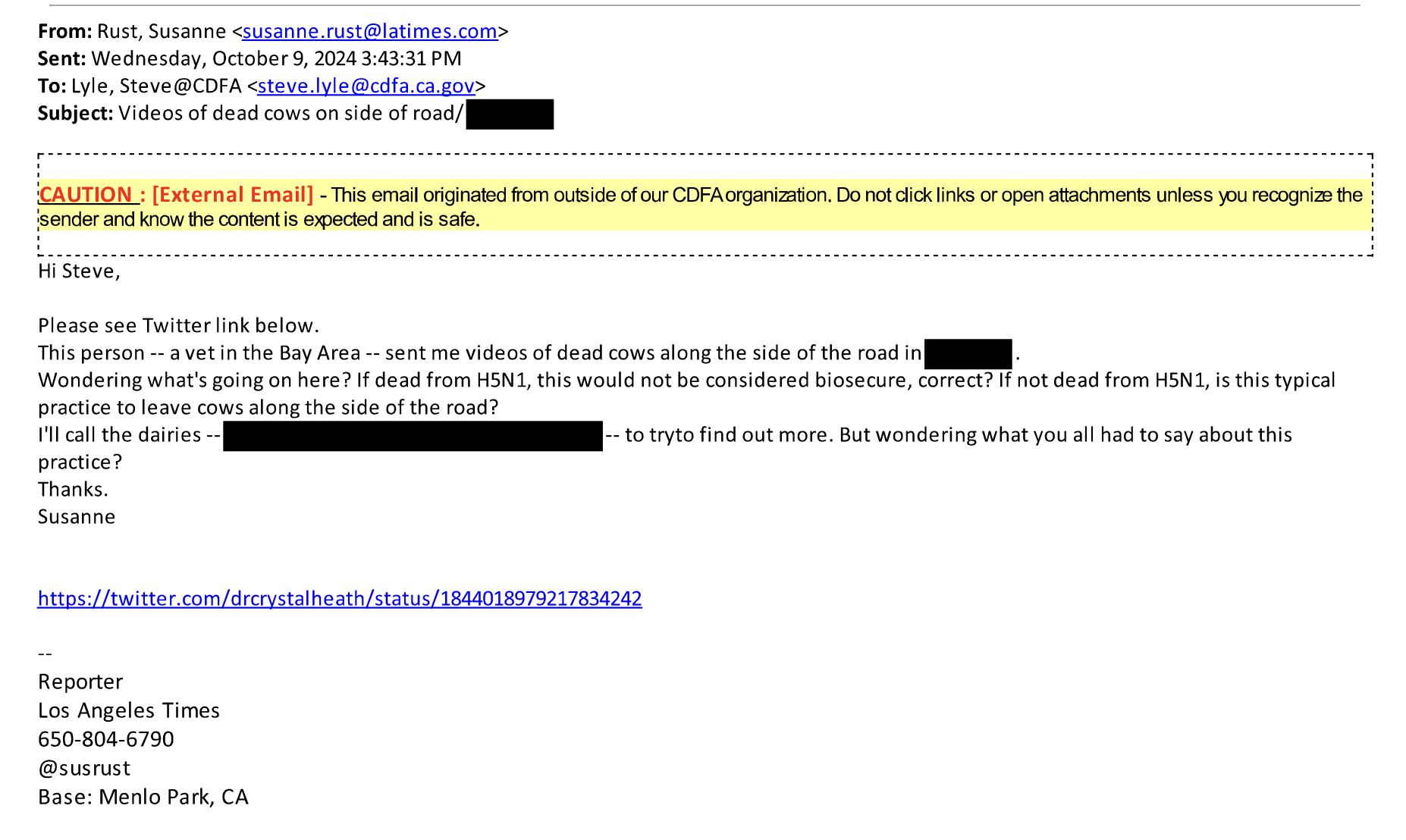
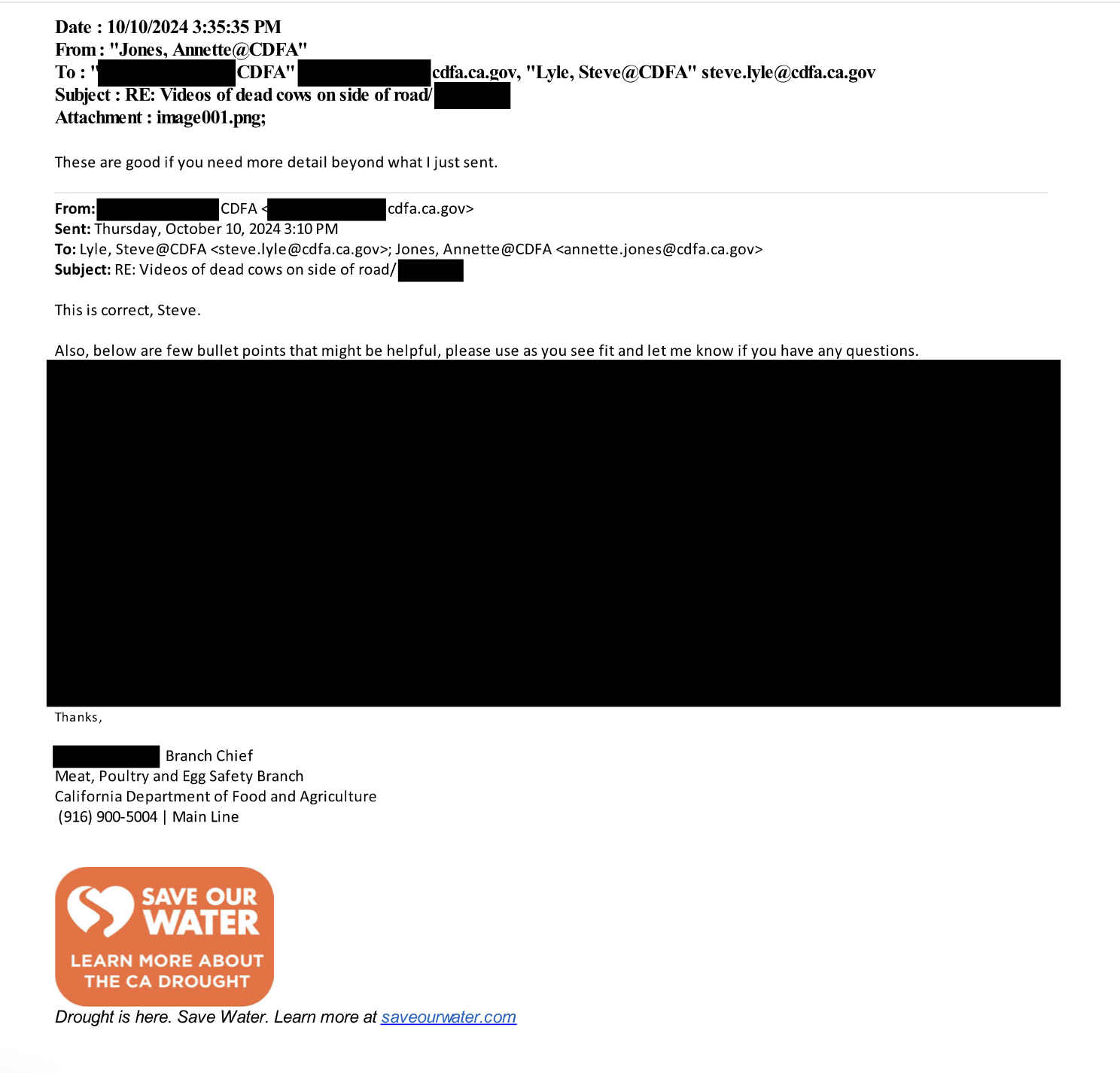
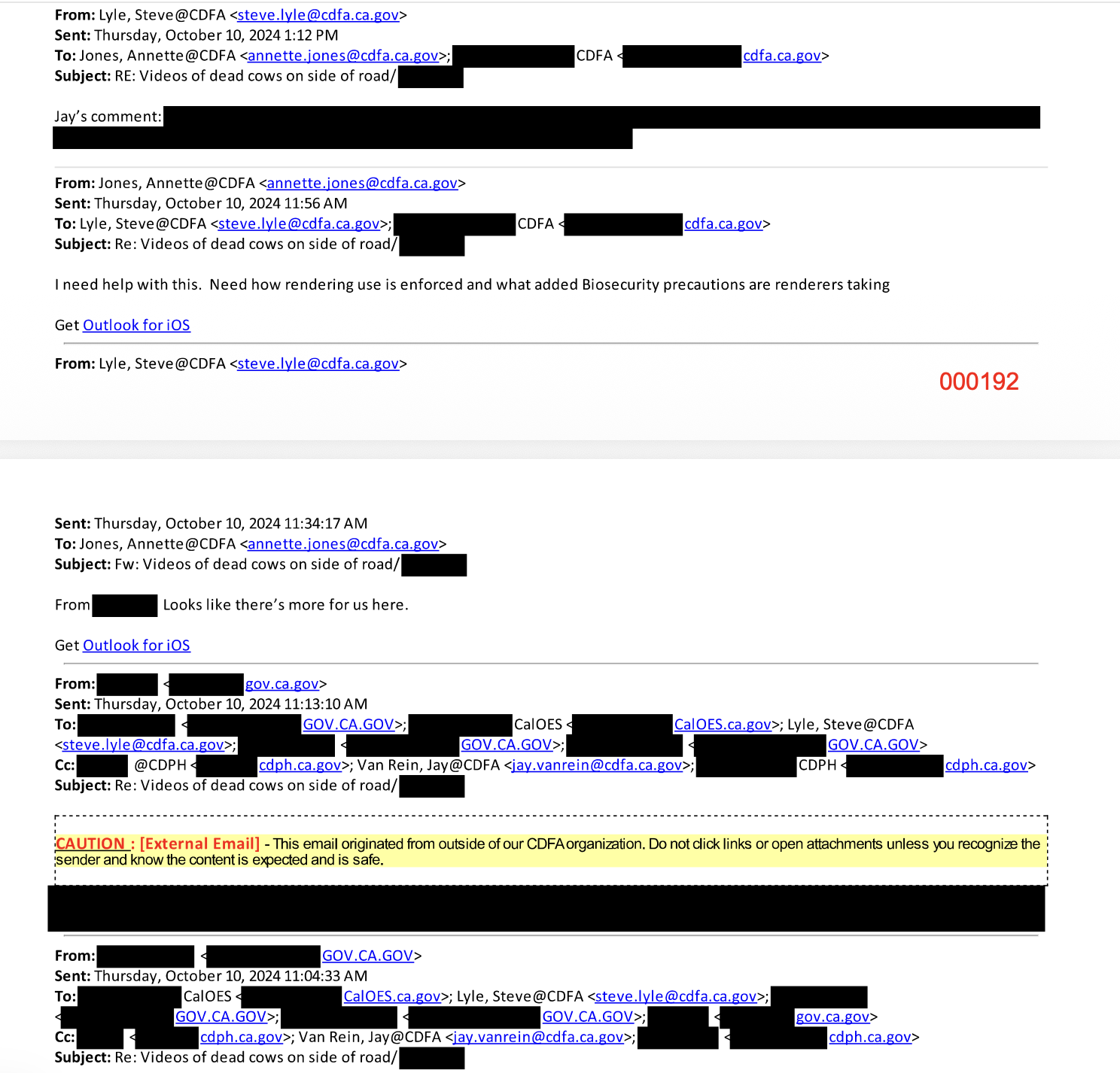
On October 9, Los Angeles Times reporter Susanne Rust sent CDFA spokesperson Steve Lyle a link to footage I had shared of dead cows near a road. She asked whether the cows had died of H5N1, whether leaving them there would be biosecure if they had, and whether this was ordinary disposal practice otherwise. Her questions prompted a chain of internal discussions involving CDFA and other state offices. Jones asked how rendering requirements were enforced and what additional precautions renderers were taking. A CDFA employee said dairies were placing carcasses closer to roads so rendering trucks would not enter the premises and potentially spread the virus, and another proposed stepping up inspections around dairies. (000188–000213.)
In a message labeled “Final Draft,” Jones asserted that CDFA had discussed the situation with the dairy and that its handling was consistent with recommendations and regulations, while the dairy had agreed to work with staff on improvements. The draft described altered truck routes, protective measures, and cleaning and disinfection. (000188.) The release does not establish that this exact draft was sent to Rust.
Phil Barber pressed CDFA for answers about a backyard flock
On October 25, The Press Democrat reporter Phil Barber pressed CDFA about HPAI in a Sonoma County backyard flock. He sought confirmation of the outbreak and asked whether every bird would be euthanized, how that would be done, what risk neighboring residents faced, and whether people keeping birds as companions could receive compensation. He said he was trying to file that evening. Lyle initially replied that he was checking with staff. In one internal forward of Barber’s inquiry, Lyle wrote, “Ugh.” (000157–000168.)
Jones later told Lyle that the freely moving chickens and turkeys thought to have been exposed had already been euthanized, while some peafowl were placed in quarantine enclosures. (000162.) The internal account does not say whether they killed every bird. The released exchange does not provide a complete count, the method used for this flock, or a clear answer to Barber’s compensation question. Lyle’s brief comment does not establish why he reacted as he did.
Disposal decisions still to be documented
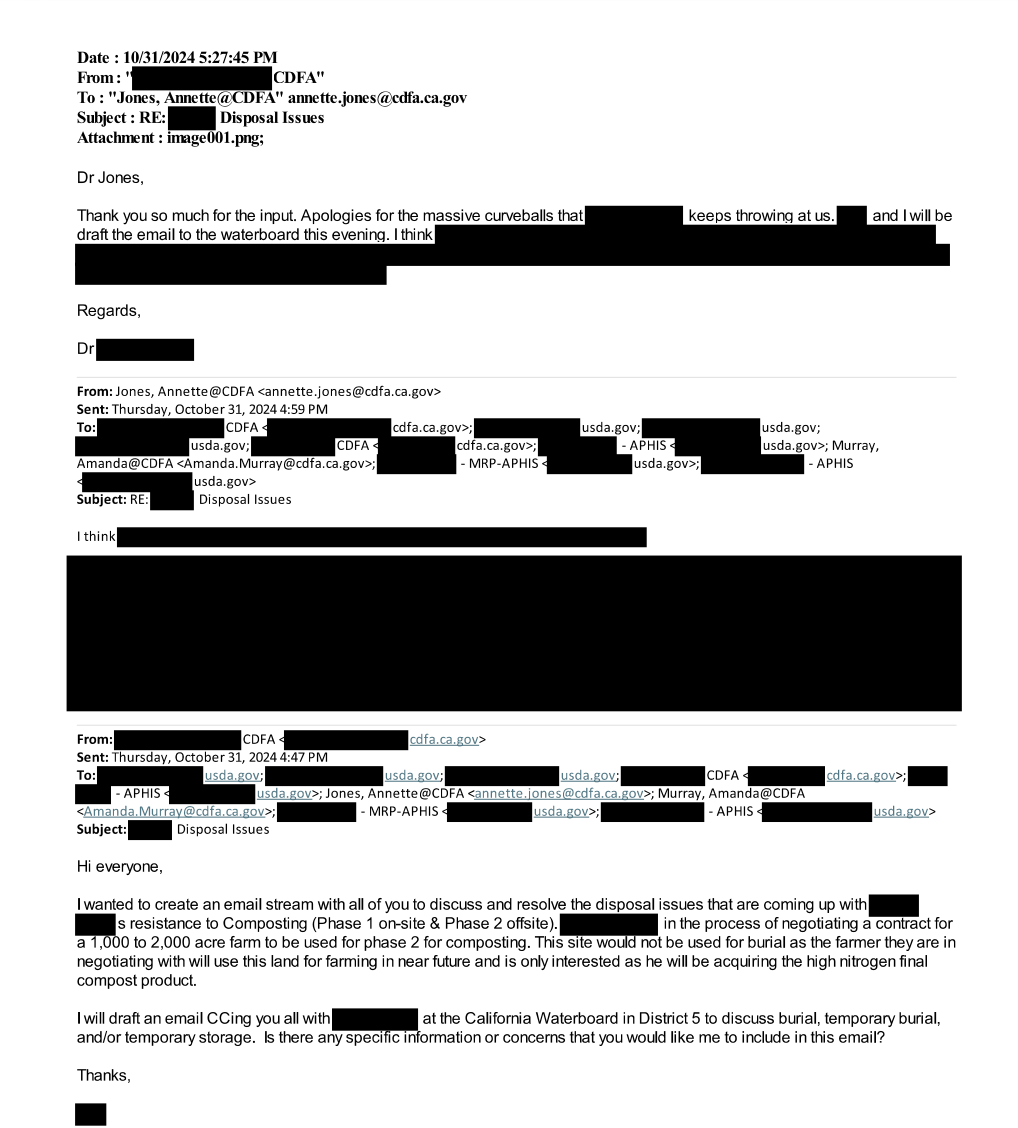
By October 31, disposal was also contested. A CDFA employee wrote that a redacted party resisted a plan involving an initial phase of composting onsite and a second phase offsite. The email described negotiations concerning a possible 1,000-to-2,000-acre farm for offsite composting and stated explicitly that the farm would not be used for burial. Separately, the employee proposed asking the regional Water Board about burial, temporary burial, or temporary storage. (000181.) These pages do not establish that the land was contracted, burial was approved, or any particular option was ultimately used.
CDFA kept tabs on how the outbreak was portrayed
The records contain detailed coverage reports prepared by the public-relations firm Ketchum for the California Milk Advisory Board and forwarded within CDFA. The reports counted news stories, social posts, potential reach, and engagement, then classified coverage as positive or negative. One report described 74% of new traditional-media coverage and 69% of social posts as negative; another put new traditional-media coverage at 83% negative, attributing much of it to reporting about rising cow deaths. The reports tracked articles by named journalists, discussion of my footage, Reddit threads, and individual social-media engagement. (000078–000084, 000117–000124.) The percentages describe coverage classified in particular reports, not all coverage of California’s outbreak.
The state veterinarian appeared to want direct access: on October 17, Jones wrote that she could obtain a report through a contact but was “trying to get us on distribution.” Lyle offered to help with the request. (000117.) These pages show sustained attention to media sentiment. They do not establish that CDFA changed a disease-control decision because coverage was negative.
CDFA circulated an Animal Agriculture Alliance bulletin about me
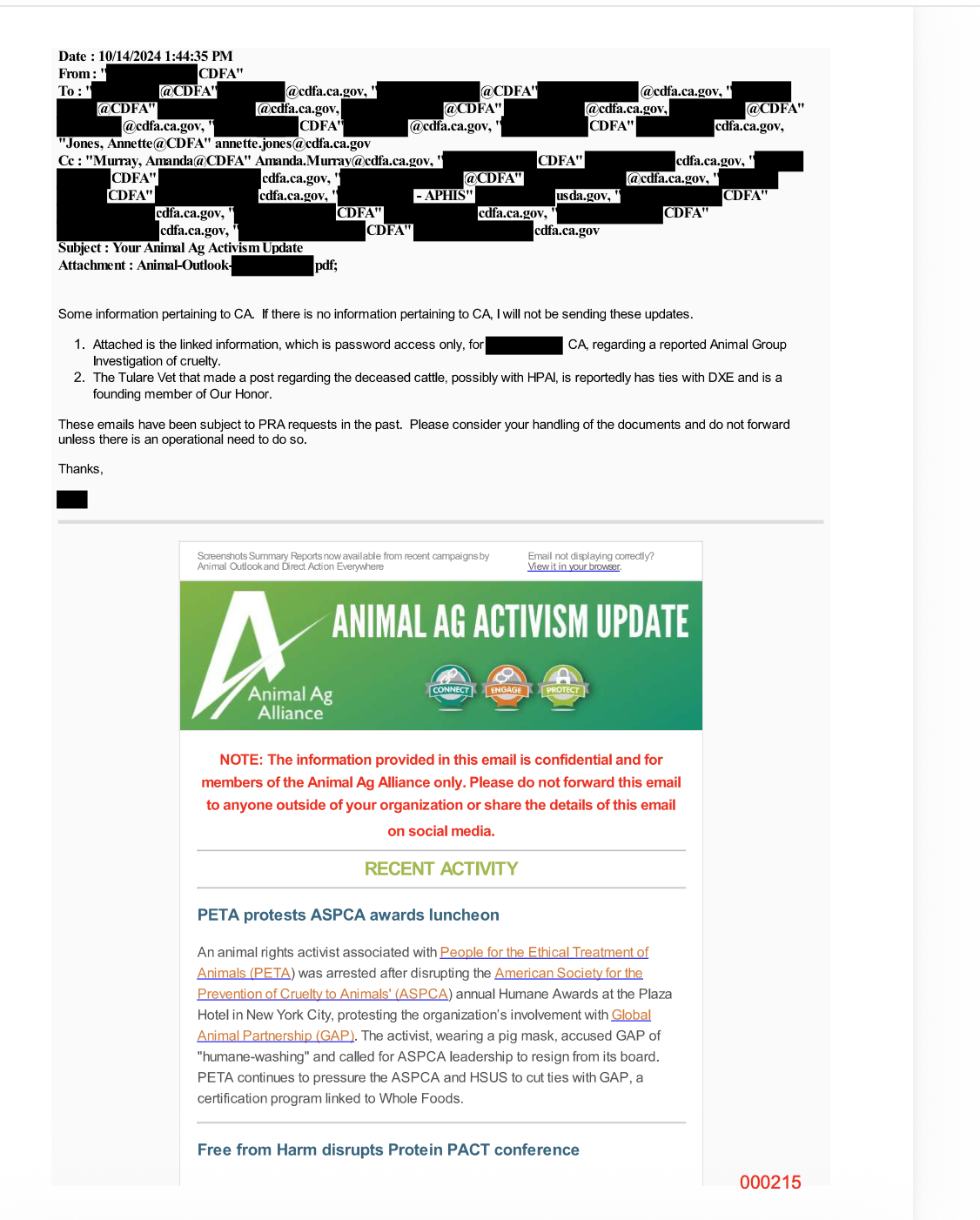
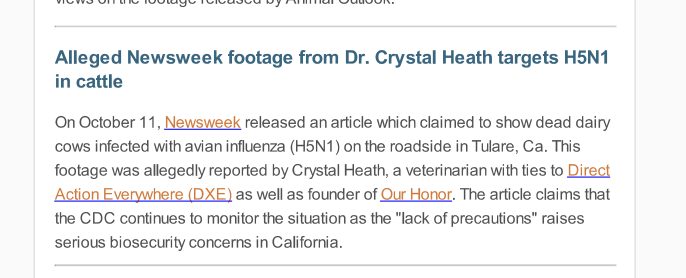
On October 14, a CDFA employee forwarded an “Animal Ag Activism Update” from the Animal Agriculture Alliance to Jones and colleagues. The bulletin identified me in a summary of a Newsweek story about my bird-flu footage and claimed ties to an animal rights organization I do not associate with. The employee repeated that characterization in the forwarding note and cautioned recipients that such emails had previously been subject to public-records requests, advising against further forwarding unless operationally necessary. The Alliance marked the bulletin confidential for members. (000215–000216.)
The Alliance is an industry-supported nonprofit. Its history gives this circulation context. Glenn Greenwald reported in The Intercept in 2020 on an earlier Alliance alert about me that encouraged members to warn veterinarian contacts. A 2025 DeSmog investigation described the Alliance’s wider monitoring of advocates and efforts to undermine critics. I see the bulletin’s purported association as an attempt to discredit my documentation rather than address what I filmed.
The newly released records establish that an industry bulletin about me was circulated inside the state agency during the outbreak. They do not show whether it shaped CDFA’s response to my footage, its handling of reporters’ questions, or any other agency decision. CDFA and the Alliance should be asked why this bulletin was shared and how it was used.
What remains unanswered
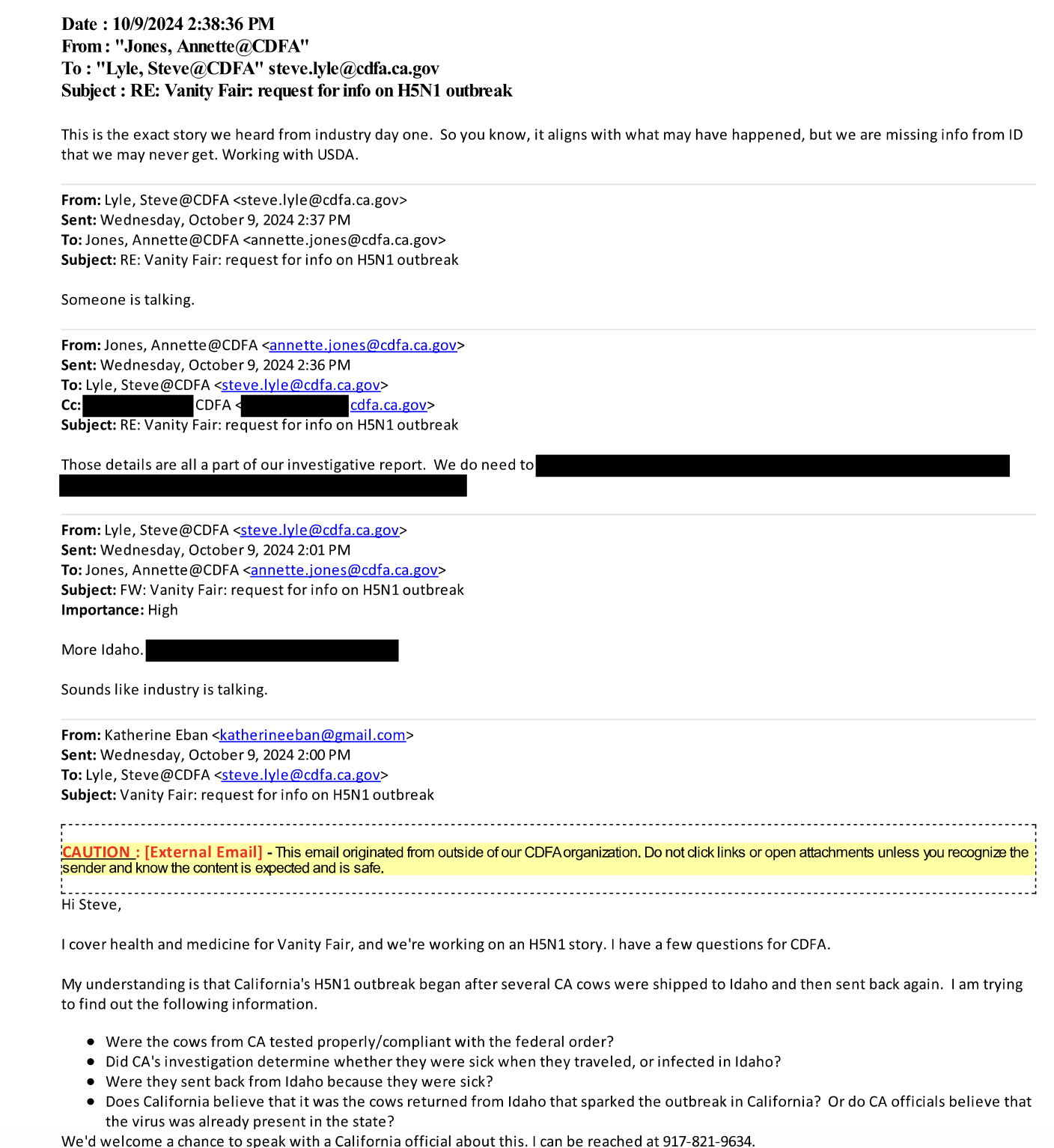
When Vanity Fair reporter Katherine Eban asked whether cattle returned from Idaho could have sparked California’s outbreak, Lyle wrote internally, “Someone is talking.” Jones replied that the account matched a story officials had heard from industry but that information from Idaho was missing and might never be obtained. (000187.) The exchange leaves the outbreak’s origin unresolved.
These emails give us questions with obtainable answers. Did any birds leave the surveillance zone? How long did each type of test take? What did the final traceback, inspection, compensation, and disposal records show? What replies did CDFA send to the reporters, and how did it use the coverage reports and industry bulletin? CDFA should release the remaining records so the public can see outcomes as well as the warnings officials exchanged in real time.
Source: CDFA Public Records Act request PID 15132, first release, Bates 000001–000268. Names and premises redacted in the release are omitted here. The two linked investigations provide background on the Animal Agriculture Alliance; they are distinct from the CDFA records.